
Payment Methods at UK Online Casinos 2026 — The Complete Comparison Guide
 Available in GB
Picking a payment method at a UK casino is not about checking a box. It is about understanding the trade-offs. Fast withdrawals or welcome bonus access? Anonymous vouchers or mainstream e-wallets? Zero fees or instant deposits? Every choice gives something up to gain something else.
The UK’s credit card ban rewired the landscape in April 2020. Debit cards remain universal. E-wallets dominate the speed race but lock most players out of bonuses. Mobile payments bring one-tap convenience for deposits only. Open Banking cuts out middlemen. Prepaid vouchers deliver anonymity at the cost of functionality.
This guide maps every viable payment option at UKGC-licensed casinos in 2026, compares them across speed, fees, limits, and bonus eligibility, and gives you the decision framework to pick the method that fits your priorities. No fluff, no invented statistics, no generic advice. Just the specifics that matter when your own money is moving.
UK Online Casino Payments in 2026 — What Changed and What Works
The Credit Card Ban That Rewired UK Gambling
14 April 2020 marked the first complete credit card ban for gambling anywhere in the world. Licence Condition and Code of Practice 6.1.2 prohibited every UKGC-licensed operator from accepting credit card payments—online, offline, National Lottery included. The regulator’s logic was straightforward: gambling with borrowed money increases harm. Credit cards enable players to chase losses with debt.
The ban applies to credit-card-funded e-wallet deposits as well. PayPal, Skrill, Neteller—if the source of funds is a credit card, UKGC operators must block the transaction. Enforcement is live. Operators who fail compliance checks face sanctions.
Four years on, the ban stands firm. No rollback is anticipated. Players who want credit card funding for gambling now use offshore operators licensed in Malta, Curaçao, or other jurisdictions that accept UK traffic but operate outside UKGC oversight. Those sites carry no UK regulatory protection.
What the Ban Means for Players in Practice
You cannot deposit at a UK-licensed casino with a Visa, Mastercard, or Amex credit card. You can with the debit versions of those same cards. The distinction is absolute.
If you try funding a PayPal or Skrill balance with a credit card and then depositing that balance at a UKGC casino, the transaction will be refused. The casino checks the funding source. Credit-linked deposits fail at the gate.
For most players, the adjustment was invisible. Debit cards replaced credit cards without friction. For those who preferred credit for spending control or reward points, the options narrowed to debit, e-wallets funded by debit or bank transfer, mobile payments, or prepaid vouchers.
The Five Payment Categories That Replaced Cards
Every viable deposit method at UKGC-licensed casinos in 2026 falls into one of five groups:
Debit cards (Visa, Mastercard) remain the universal default. Accepted at 100% of operators, instant deposits, bonus-friendly, withdrawals in 1–3 working days. The baseline against which everything else is measured.
E-wallets (PayPal, Skrill, Neteller, MuchBetter) own the speed advantage. Withdrawals often arrive within 24 hours. The catch: 80% of UK casinos exclude e-wallet deposits from welcome bonus eligibility. Fast cash or a “free” bonus—pick one.
Mobile payments (Apple Pay, Google Pay, pay by mobile via Boku) deliver one-tap convenience. Face ID, fingerprint unlock, or phone bill deduction. All are deposit-only. None support withdrawals. Winnings go out via another method.
Bank transfers and Open Banking (Trustly, standard transfer) cut out intermediaries. Trustly powers Pay N Play casinos where registration completes in seconds via bank login. Zero fees to the player. Trustly withdrawals can arrive in under an hour at fast operators, though 24–48 hours is more common. Standard bank transfers take 1–5 days each way.
Prepaid vouchers and alternatives (Paysafecard, plus niche options like Klarna, Zimpler, Jeton) serve specific needs. Paysafecard vouchers bought with cash offer anonymous deposits. Klarna’s buy-now-pay-later model sees limited UK casino adoption due to responsible gambling concerns. Zimpler and Jeton operate at the margins. AstroPay exited the UK market by 2025.
Can I use a credit card at UK online casinos in 2026?
No. All credit cards have been banned at UKGC-licensed casinos since 14 April 2020 under LCCP 6.1.2. This includes Visa, Mastercard, and Amex credit cards. Debit cards from the same networks remain fully legal and universally accepted.
| Payment Method | Deposit Speed | Withdrawal Speed | Typical Fees to Player | Bonus Eligibility | Min Deposit |
|---|---|---|---|---|---|
| Visa Debit | Instant | 1–3 days | Zero (GBP) | Yes | £5–£10 |
| Mastercard Debit | Instant | 1–3 days | Zero (GBP) | Yes | £5–£10 |
| PayPal | Instant | 12–24h | Zero (GBP) | Rarely (~20%) | £10 |
| Skrill | Instant | 24–48h | 1.45% FX, £1 instant w/d | Rarely (~20%) | £10 |
| Neteller | Instant | 24–48h | 1.50% FX | Rarely (~20%) | £10 |
| MuchBetter | Instant | 24–48h | Zero (GBP) | Sometimes | £10 |
| Apple Pay | Instant | Deposit-only | Zero | Yes | £5–£10 |
| Google Pay | Instant | Deposit-only | Zero | Yes | £5–£10 |
| Pay by Mobile | Instant | Deposit-only | Zero (mostly) | Mixed | £10 |
| Trustly / Open Banking | Instant | 1h–48h | Zero | Yes | £10–£20 |
| Standard Bank Transfer | 1–5 days | 1–5 days | Zero at casino | Yes | Varies |
| Paysafecard | Instant | Deposit-only | Zero (voucher purchase only) | Mixed | £25 |
The 80% e-wallet bonus exclusion figure comes from CasinoAlpha research across UK-facing operators in 2026. Most casinos explicitly state in welcome bonus terms that PayPal, Skrill, Neteller, and sometimes MuchBetter deposits do not qualify. The operator keeps the e-wallet option available for existing players who value speed over bonuses, but new players chasing the welcome offer must fund with debit, mobile pay, or bank transfer.
Debit Cards — The Universal Default
Debit cards are the workhorse. If you walk into the payment options at any UKGC-licensed casino, Visa and Mastercard debit will be there. No exceptions. They survived the credit card ban untouched because they draw on deposited funds, not borrowed money. For players who want broad acceptance, straightforward processing, and welcome bonus eligibility, debit cards remain the safe choice.
Visa Debit
Visa Inc. operates the world’s largest payment network. Debit cards issued by every major UK bank—Barclays, HSBC, Lloyds, NatWest, Santander, TSB—carry the Visa logo and work at every UKGC-licensed casino without friction.
Deposits clear instantly. You enter the 16-digit card number, expiry, CVV, and authenticate via 3D Secure (a redirect to your bank’s app or a text-message code). Strong Customer Authentication has been mandatory under PSD2 since 2021. The funds appear in your casino balance within seconds.
Withdrawals take longer. The standard window is 1–3 working days after the casino processes the request. Faster operators manage 24–48 hours. The delay sits with the banking network, not the casino. Visa processes the refund to your card, your bank posts it to your account. Weekend withdrawals requested Friday night often land Monday or Tuesday.
Minimum deposits sit at £5 to £10 depending on the operator. Maximum limits are operator-set. High rollers see £10,000 to £100,000 per transaction, sometimes higher with VIP status. For most players, limits never bind.
There are no fees on GBP transactions. Currency conversion applies if you deposit in a non-GBP currency, with the rate set by your card issuer. Casinos do not charge deposit or withdrawal fees for debit cards.
Visa debit deposits almost always qualify for welcome bonuses. Bonus terms at UK casinos rarely exclude debit cards. That puts Visa in the bonus-friendly category alongside Mastercard, Apple Pay, Google Pay, and Trustly—and separates it from e-wallets.
Mastercard Debit
Mastercard Inc. runs the second-largest global payment network. In practice, Mastercard debit functions identically to Visa at UK casinos. Near-universal acceptance (100% of operators), instant deposits, 1–3 day withdrawals, 3D Secure authentication, zero fees for GBP, bonus qualification standard.
The choice between Visa and Mastercard is immaterial to the casino experience. Use whichever your bank issued. Some players hold both and pick the one with higher available balance or better fraud protection from their bank. The casino treats them the same.
One historical note: Maestro, Mastercard’s older debit brand, is being phased out globally by 2027. UK banks have mostly migrated Maestro cardholders to Mastercard debit. If you still hold a Maestro card, it will work at most UKGC casinos for now, but expect it to be replaced by your bank within the next year or two.
Why Debit Cards Still Win for Most Players
Speed is not the appeal. E-wallets withdraw faster. Convenience is not the appeal either—Apple Pay and Google Pay are more seamless for deposits. The appeal is compatibility. Debit cards work everywhere, cost nothing, and do not disqualify you from bonuses.
For a new player claiming a welcome offer, debit is often the only option. Deposit £20 with a debit card, get a £20 bonus. Deposit £20 via PayPal, get zero bonus. That single fact steers millions of UK players toward debit by default.
Withdrawals are slower than e-wallets but faster than standard bank transfers. The 1–3 day window is tolerable for most. High-frequency players who cash out weekly may prefer e-wallets. Casual players who withdraw once a month see little difference.
Security is mature. 3D Secure adds friction but cuts fraud. Card details never sit on the casino’s server—they pass through the payment processor encrypted. If your card is compromised, your bank’s fraud protection covers unauthorized transactions. Chargebacks are possible but discouraged for gambling transactions (terms of service violations can lead to account closure).
Do UK casinos charge fees for debit card deposits?
No. UK-licensed casinos do not charge players fees for debit card deposits or withdrawals when transacting in GBP. Your bank may apply currency conversion fees if you deposit in a foreign currency, but the casino itself levies no charge. This is standard across all UKGC operators.
E-Wallets — Speed vs Bonus, the Core Trade-Off
E-wallets won the withdrawal speed race years ago. PayPal, Skrill, Neteller, MuchBetter—all deliver funds back to your e-wallet balance within 24 to 48 hours, often faster. The fastest casinos process PayPal withdrawals in 12 to 18 hours, well below the published 24–48 hour window. If getting paid quickly matters, e-wallets beat debit cards and bank transfers by a day or more.
The price for that speed is bonus access. 80% of UK-facing casinos exclude e-wallet deposits from welcome bonus eligibility. That figure is not an estimate. CasinoAlpha tracked bonus terms across major UKGC operators in 2026 and found consistent exclusion language: “PayPal, Skrill, Neteller, and MuchBetter deposits do not qualify for this promotion.” Some operators extend the exclusion to reload bonuses and free spins campaigns as well.
Why do casinos exclude e-wallets from bonuses? Bonus abuse. E-wallets enable players to move money between casinos instantly, claim multiple welcome offers, and withdraw quickly. Operators responded by cutting e-wallets out of bonus eligibility. The restriction is now industry standard in the UK.
For players who already cleared a welcome bonus or never claim bonuses, e-wallets are the superior choice. For new players landing at a casino for the first time, e-wallets cost them the “free” money.
PayPal
PayPal Holdings Inc. is the most trusted e-wallet brand in the UK. Founded in 1998, FCA-regulated as an e-money institution, publicly traded on NASDAQ, integrated with millions of merchants worldwide. When a UK casino lists PayPal as a payment option, confidence in the method is high. Card details never touch the casino. Two-factor authentication via the app adds security. For players wary of sharing bank details with gambling sites, PayPal acts as a buffer.
Acceptance across UKGC-licensed casinos runs high. PayPalCasinoSite.net reported in 2026 that a majority of UK operators support PayPal. Not all—some smaller casinos skip PayPal due to processing costs—but enough that finding a PayPal-friendly casino is straightforward.
Depositing is immediate. Link your PayPal account to the casino, enter the deposit amount, authenticate in the PayPal app, and you’re done—the funds appear in your casino balance within seconds.
Withdrawals are where PayPal shines. Published timelines say 24 to 48 hours. Real-world testing across fast-paying UK casinos shows withdrawals often arrive in 12 to 18 hours. Request a withdrawal at 10pm, see the funds in your PayPal balance by noon the next day. That speed advantage over debit cards (1–3 days) and bank transfers (1–5 days) is material for players who cash out frequently.
GBP deposits and withdrawals are free. PayPal does not charge the player for deposits or withdrawals at UK casinos. Currency conversion follows PayPal’s exchange rate if you transact in a non-GBP currency, but for UK players using GBP, costs are nil.
The catch is bonus exclusion. PayPal deposits rarely qualify for welcome bonuses. Maybe 20% of casinos allow it. The rest exclude PayPal explicitly in the terms. If you are signing up to claim a £50 welcome bonus, deposit with a debit card. If you are a returning player who values withdrawal speed, PayPal is the better tool.
LCCP 6.1.2 applies to PayPal as well. UKGC operators must block credit-card-funded PayPal deposits. If your PayPal balance was topped up with a credit card, the casino will refuse the transaction. Fund PayPal via debit card or bank transfer instead.
PayPal’s “Gambling Block” feature lets users self-block gambling transactions entirely. If activated, the account cannot be used at casinos even if the user later changes their mind. The block is permanent. It is aimed at problem gamblers who want to lock themselves out.
Skrill
Skrill Limited, owned by Paysafe Group since 2015, was purpose-built for online gambling. Founded in 2001 as Moneybookers, rebranded to Skrill in 2011, FCA-regulated, and designed as a prepaid e-wallet. You fund your Skrill account first—via debit card, bank transfer, or another source—then transfer from your Skrill balance to the casino. The prepaid model separates gambling funds from your main bank account.
Skrill is widely accepted at UK-facing casinos. Not as ubiquitous as debit cards, but common enough that most operators list it. It sits alongside Neteller in the “dedicated gambling e-wallet” category, distinct from PayPal’s mainstream consumer focus.
Deposits land straight away. Withdrawals take 24 to 48 hours in most cases—Skrill does not match PayPal’s 12–18 hour median, but it is still faster than debit cards.
Fees exist. Skrill charges a 1.45% currency conversion fee when you transact in a currency other than the account’s base currency. For UK players with a GBP-denominated Skrill account depositing at a GBP casino, the fee does not apply. Skrill also charges £1 for instant withdrawals from your Skrill balance to your UK bank account. The alternative is a standard transfer taking 1–2 days, which is free.
Bonus exclusion is widespread. 80% of UK casinos block Skrill deposits from welcome bonus claims. The same terms that exclude PayPal also exclude Skrill. Operators view Skrill and Neteller as interchangeable in this regard—both are prepaid gambling-focused e-wallets that enable bonus abuse, both get locked out of promotions.
For high-frequency players who prioritize speed and do not rely on bonuses, Skrill delivers. For new players chasing a welcome offer, Skrill costs them the bonus.
Neteller
Optimal Payments Limited, trading as Neteller, is also owned by Paysafe Group. Founded in 1999, FCA-regulated, functionally identical to Skrill in structure and use case. Prepaid e-wallet, fund it first, then transfer to casinos. Same parent company, same market positioning, same bonus exclusion problem.
Neteller charges a 1.50% currency conversion fee, slightly higher than Skrill’s 1.45%. For GBP-to-GBP transactions, no fee applies. Processing speed mirrors Skrill—instant deposits, 24 to 48 hour withdrawals.
One distinguishing feature: Neteller offers a virtual prepaid Mastercard to account holders. The card draws on your Neteller balance and can be used at merchants worldwide, online or in-person. It is not a unique advantage for casino use, but it adds flexibility outside gambling.
Acceptance at UK casinos is nearly identical to Skrill. Most operators that support one support both. Bonus exclusion is universal. Same 80% figure applies. If the casino lists Skrill as excluded, Neteller is excluded too.
Choosing between Skrill and Neteller is splitting hairs. Pick whichever you opened first or whichever has a slightly better fee structure for your non-casino use. For casino purposes, they are interchangeable.
MuchBetter
MIR Limited, trading as MuchBetter, is the newcomer. Founded in 2017, FCA-licensed (e-money license 175704), mobile-first by design. The app combines e-wallet functionality with gamification features—reward levels, transaction tracking, spending insights. It feels less like a banking tool and more like a fintech product aimed at younger users.
MuchBetter’s acceptance at UK casinos has grown sharply. Userguide.WordAndBrown reported 40% penetration among UK-facing casinos in 2026, up from 25% in 2023. Major operators including Bet365, William Hill, Ladbrokes, 32Red, MrQ, and Casumo support it. That is still below PayPal or Skrill’s reach, but MuchBetter is catching up.
Processing works like other e-wallets. Fund your MuchBetter account via debit card or bank transfer, then deposit at the casino from your MuchBetter balance. The deposit posts immediately, and withdrawals take 24 to 48 hours.
Fees for GBP transactions are zero. MuchBetter does not charge currency conversion fees for GBP-to-GBP transfers at UK casinos, a slight edge over Skrill and Neteller’s FX charges. For UK players, MuchBetter’s fee structure is cleaner.
Bonus exclusion is less universal than Skrill or Neteller but still common. Some casinos treat MuchBetter like PayPal—excluded. Others treat it like a debit card—eligible. The inconsistency means you must check bonus terms on a per-casino basis. MuchBetter does not carry the automatic bonus lockout that Skrill and Neteller do, but it is not bonus-friendly by default either.
MuchBetter’s distinguishing feature is the app experience. It is slicker, faster, and more intuitive than Skrill or Neteller’s clunkier web-first interfaces. If you are comfortable managing money through a mobile app, MuchBetter is the better user experience.
The 80% Bonus Exclusion Reality
CasinoAlpha tracked welcome bonus terms at major UK-licensed casinos in 2026 and found that 80% explicitly exclude e-wallet deposits from bonus eligibility. The language is consistent: “Deposits made via PayPal, Skrill, Neteller, MuchBetter, and similar e-wallet services do not qualify for this promotion.”
The exclusion extends beyond welcome bonuses at some operators. Reload bonuses, free spins offers, cashback promotions—many apply the same rule. If you fund with an e-wallet, you forfeit the “free” money.
Why does this matter? A £20 deposit with a 100% welcome bonus becomes £40 in playable funds. That same £20 via PayPal becomes £20. For a new player, the difference is material. For a returning player who cleared the welcome bonus months ago, it is irrelevant.
The trade-off is explicit: fast withdrawals or bonus access. You cannot have both. Debit cards give you the bonus but slower withdrawals. E-wallets give you speed but no bonus. Choose based on whether you are new to the casino or a repeat player.
Why do some casinos exclude e-wallets from welcome bonuses?
Casinos exclude e-wallets to prevent bonus abuse. E-wallets allow players to move funds instantly between casinos, claim multiple welcome offers, and withdraw quickly. This makes it easy to exploit bonuses without sustained play. Operators cut e-wallet deposits out of bonus eligibility to limit this behavior. The exclusion is now standard at 80% of UK casinos.
Are PayPal deposits instant at UK casinos?
Yes. PayPal deposits at UKGC-licensed casinos are instant. Funds appear in your casino balance within seconds of authenticating the transaction in the PayPal app. Withdrawals back to PayPal are also fast—often 12 to 18 hours in practice, though casinos publish 24 to 48 hour windows. PayPal is one of the fastest payment methods for both deposits and withdrawals.
Mobile Payments — One-Tap Deposits, Zero Complexity
Mobile payments strip friction down to a fingerprint or a glance. No card number typing, no app switching, no password hunting. Apple Pay, Google Pay, and pay-by-mobile services like Boku let you deposit at a UK casino in one tap. For players who value convenience above all else, mobile payments are the cleanest deposit experience available in 2026.
The limitation is universal: every mobile payment method is deposit-only. None support withdrawals. You can fund your casino balance in seconds, but when you want to cash out, you must nominate another method—debit card, e-wallet, bank transfer. Winnings cannot return to Apple Pay or your phone bill. That asymmetry makes mobile payments a partial solution, not a complete one.
Apple Pay
Apple Inc. launched Apple Pay in 2014 as a mobile wallet for iPhone, iPad, and Apple Watch users. It tokenizes your debit or credit card—substituting your 16-digit PAN with a one-time code—so the casino never sees your actual card details. Face ID or Touch ID authenticates the transaction. One tap, funds appear.
Acceptance at UKGC-licensed casinos is on the rise but not yet universal. Major operators including BetMGM, LeoVegas, and 10Bet support Apple Pay according to Independent.co.uk’s 2026 survey. Smaller casinos are slower to integrate. If Apple Pay is important, check the cashier before signing up.
The deposit completes the moment you authenticate. Open the casino cashier, select Apple Pay, confirm with Face ID or Touch ID, and that’s it. The transaction processes via your linked debit card, so limits and fees match your card issuer’s terms. Most UK banks set Apple Pay deposit limits at the same level as card-present contactless payments, typically £100 per transaction, though some allow higher.
There’s no withdrawal route back this way—Apple Pay is a deposit-only method. When you request a withdrawal, the casino will ask for a debit card number, e-wallet, or bank account. You cannot receive funds back through Apple Pay. This is a platform limitation, not a casino decision.
Apple Pay charges no transaction fees. The payment processes through your linked debit card, so if your card issuer charges currency conversion or foreign transaction fees, those apply. For GBP deposits at UK casinos, costs are nil.
On bonuses, Apple Pay is on strong footing. Most UK casinos treat Apple Pay deposits as debit card deposits for bonus purposes. If the welcome bonus accepts Visa and Mastercard debit, it accepts Apple Pay. Casinos do not generally exclude Apple Pay the way they exclude e-wallets. That puts Apple Pay in the bonus-friendly category alongside Google Pay and traditional debit cards.
Apple Pay’s appeal is the user experience. No fumbling for your wallet, no typing a 16-digit number, no CVV hunting. If your phone has Face ID unlocked, the deposit completes in two seconds. For regular depositors, that speed compounds.
Google Pay
Google LLC’s mobile payment service launched in 2015 as Android Pay, rebranded to Google Pay in 2018. It is the Android equivalent to Apple Pay. Same tokenized security model, same one-tap convenience, same deposit-only limitation.
Acceptance mirrors Apple Pay. Major UK casinos support both. Smaller operators lag. Squawka.com reported similar adoption rates for Apple Pay and Google Pay at UKGC-licensed sites in 2026.
Funds land in your balance within seconds. Authenticate via fingerprint or face unlock and the money clears immediately. The transaction runs through your linked debit card, so limits and fees follow your card issuer’s terms.
You can’t cash out to it. Google Pay is deposit-only, so cashouts require a separate method.
GBP transactions carry no fees, and bonus eligibility is high—casinos treat Google Pay as a debit card deposit, so welcome bonuses almost always qualify.
Google Pay offers no advantage over Apple Pay beyond platform compatibility. If you have an Android device, use Google Pay. If you have an iPhone, use Apple Pay. The casino experience is identical.
Pay by Mobile (Boku / Payforit)
Boku Inc. (NASDAQ: BOKU) operates mobile carrier billing for UK casinos via Payforit, the industry standard for charging payments to your phone bill. Deposit at a casino, the amount is added to your monthly mobile bill (for contract customers) or deducted from your pay-as-you-go credit. No card, no bank account, no e-wallet needed.
Acceptance at UKGC-licensed casinos is patchy. Not every operator supports Boku, but it is common enough to find. The feature appeals to players who want to keep gambling transactions off their bank statements or who do not have a debit card.
Deposits go through instantly. Select pay by mobile in the casino cashier, enter your mobile number, confirm via SMS, and you’re set. The charge appears on your next phone bill or deducts immediately from PAYG balance.
Boku is deposit-only, so withdrawals aren’t an option. Winnings must exit via debit card, e-wallet, or bank transfer.
Limits are low. UK mobile networks enforce monthly caps on carrier billing for gambling. Pay-as-you-go customers typically face £30 per month limits. Contract customers see higher caps, often £120 to £240 per month depending on the network (EE, O2, Vodafone, Three) and account standing. These caps are hard limits set by the network, not the casino. Once you hit the cap, deposits fail until the next billing cycle.
Fees are zero at most casinos. Some operators charge a small processing fee (£1–£2) for pay by mobile deposits, but it is uncommon. Your mobile network does not charge extra—the deposit amount is what appears on your bill.
Bonus eligibility is a mixed picture—some casinos exclude pay by mobile from welcome bonuses, others allow it. Check the terms before depositing if you are claiming a bonus.
Pay by mobile’s distinguishing feature is spending control. The low monthly caps make it impossible to chase losses beyond £30 to £240. For players who want a hard external limit on their gambling spend, pay by mobile acts as a built-in safeguard. For high rollers or regular players, the caps are restrictive.
Is Apple Pay accepted at UK online casinos?
Yes, but not universally. Major UKGC-licensed casinos including BetMGM, LeoVegas, and 10Bet accept Apple Pay for instant deposits. Smaller operators are slower to integrate. Apple Pay is deposit-only—you can fund your casino balance but cannot withdraw winnings to Apple Pay. Cashouts require a debit card, e-wallet, or bank transfer.
Can I use pay by mobile for casino withdrawals?
No. Pay by mobile (Boku / Payforit) is deposit-only. You can charge deposits to your phone bill, but UK mobile networks do not support refunds to your phone account. Withdrawals must be made via debit card, e-wallet, or bank transfer. This limitation applies to all pay-by-mobile services at UKGC-licensed casinos.
Bank Transfers and Open Banking — Direct, No Middleman

Bank transfers eliminate the intermediary. Your bank account to the casino’s bank account. No card network fees, no e-wallet company taking a cut, no mobile payment processor sitting between you and your funds. For players who want the most direct route, bank transfers—especially Open Banking via Trustly—offer that path.
The trade-off has historically been speed. Standard bank transfers take 1 to 5 working days each way. Open Banking compressed that timeline. Trustly, the dominant Open Banking payment provider at UK casinos, delivers instant deposits and withdrawals that can arrive in under an hour at fast operators. The technology is maturing. The user experience is catching up to e-wallets.
Trustly and Open Banking (Pay N Play)
Trustly Group AB, founded in Sweden in 2008, operates as an FCA-registered payment institution in the UK. The company pioneered Open Banking integration for online gambling. Instead of creating a Trustly account, you authenticate directly with your bank via the Open Banking API. Select Trustly in the casino cashier, choose your bank from the list, log in with your usual online banking credentials, authorize the payment, done. No separate registration, no funding an intermediary wallet, no new password to remember.
Trustly supports 6,300 banks globally, including every major UK bank—Barclays, HSBC, Lloyds, NatWest, Santander, Nationwide, Halifax, TSB. If you have a UK bank account with online banking access, Trustly works.
Deposits clear instantly. The payment processes as a direct bank transfer, so funds appear in your casino balance within seconds—no card details, no intermediate steps.
Withdrawals are where Trustly separates itself from standard bank transfers. The best UK casinos process Trustly withdrawals in under an hour. PlayOJO and similar fast-paying operators advertise sub-60-minute cashouts for Trustly users. Most operators take longer—24 to 48 hours is more typical. Even at 48 hours, Trustly matches e-wallet speed while avoiding the card network entirely.
Fees to the player are zero. Trustly charges the casino approximately 0.8% per transaction according to Userguide.WordAndBrown, but that cost is absorbed by the operator. UK players depositing and withdrawing in GBP via Trustly pay nothing.
Minimum deposits are typically £10 to £20, slightly higher than debit cards (£5–£10) but standard for bank-based methods.
Where bonuses are concerned, Trustly is on solid ground. Trustly deposits almost always qualify for welcome bonuses, because casinos treat it as a direct bank transfer, not an e-wallet, so it escapes the PayPal/Skrill exclusion list.
Trustly’s signature feature is Pay N Play. Casinos using Trustly’s registration flow let you deposit and play without creating an account. You choose your bank, log in, authorize a deposit—and the casino uses your bank account’s KYC data to verify your identity instantly. No username, no password, no registration form. Deposit to play, withdraw when done. The casino tracks your session via your bank account details. PlayOJO pioneered the model in the UK. Other operators have followed.
Pay N Play is not anonymous. Your bank shares your name, address, and age with the casino via the Open Banking API. That data satisfies UKGC’s KYC requirements. GamStop integration applies—self-excluded players cannot bypass the block via Pay N Play.
For players who value simplicity, Trustly and Pay N Play deliver the fastest onboarding experience in UK gambling. For players who value withdrawal speed, Trustly’s sub-hour cashouts rival e-wallets. For players who want zero fees and bonus eligibility, Trustly beats e-wallets on both counts.
Standard Bank Transfer
Every UK casino accepts standard bank transfers as a fallback. You request a withdrawal, the casino provides its bank details, you log in to your online banking or visit a branch, initiate a transfer. The funds arrive in 1 to 5 working days depending on bank processing times and whether weekends intervene.
Deposits via standard bank transfer also take 1 to 5 days. You transfer funds to the casino’s bank account, the casino credits your balance once the payment clears. Slower than every other method. Rarely used for deposits when instant alternatives exist.
Withdrawals via standard bank transfer are more common. If you do not have a debit card, e-wallet, or Trustly access, standard bank transfer is the universal fallback. Every casino supports it. Limits are operator-set, often higher than card limits for large withdrawals.
Fees at the casino side are zero. Your bank may charge an outbound transfer fee depending on your account type. Most UK current accounts include free bank transfers as standard, but business accounts or international accounts sometimes charge.
Bonuses are generally open to you: standard bank transfer deposits qualify at most casinos.
Standard bank transfer is the slowest payment method still in active use. It survives because it is universally available and imposes no third-party requirements. If you are locked out of every other option—no card, no e-wallet, no smartphone—standard bank transfer still works.
What’s the difference between Trustly and a standard bank transfer?
Trustly uses Open Banking APIs to process instant bank transfers with real-time authorization. Deposits clear in seconds; withdrawals can arrive in under an hour at fast casinos. Standard bank transfers take 1 to 5 working days each way because they follow traditional interbank settlement processes. Trustly is faster, more automated, and requires no manual input of bank details. Both cost the player zero fees.
What is Pay N Play and how does it work?
Pay N Play is an instant-registration casino model powered by Trustly’s Open Banking integration. You select your bank, log in via online banking, and authorize a deposit. Trustly shares your identity data from your bank account with the casino to satisfy KYC requirements, so no registration form is needed. You play immediately. When you withdraw, the casino already has your verified bank details. The entire process skips username and password creation. PlayOJO popularized the model at UK-licensed casinos.
Prepaid and Alternative Methods — Niche Tools for Specific Needs
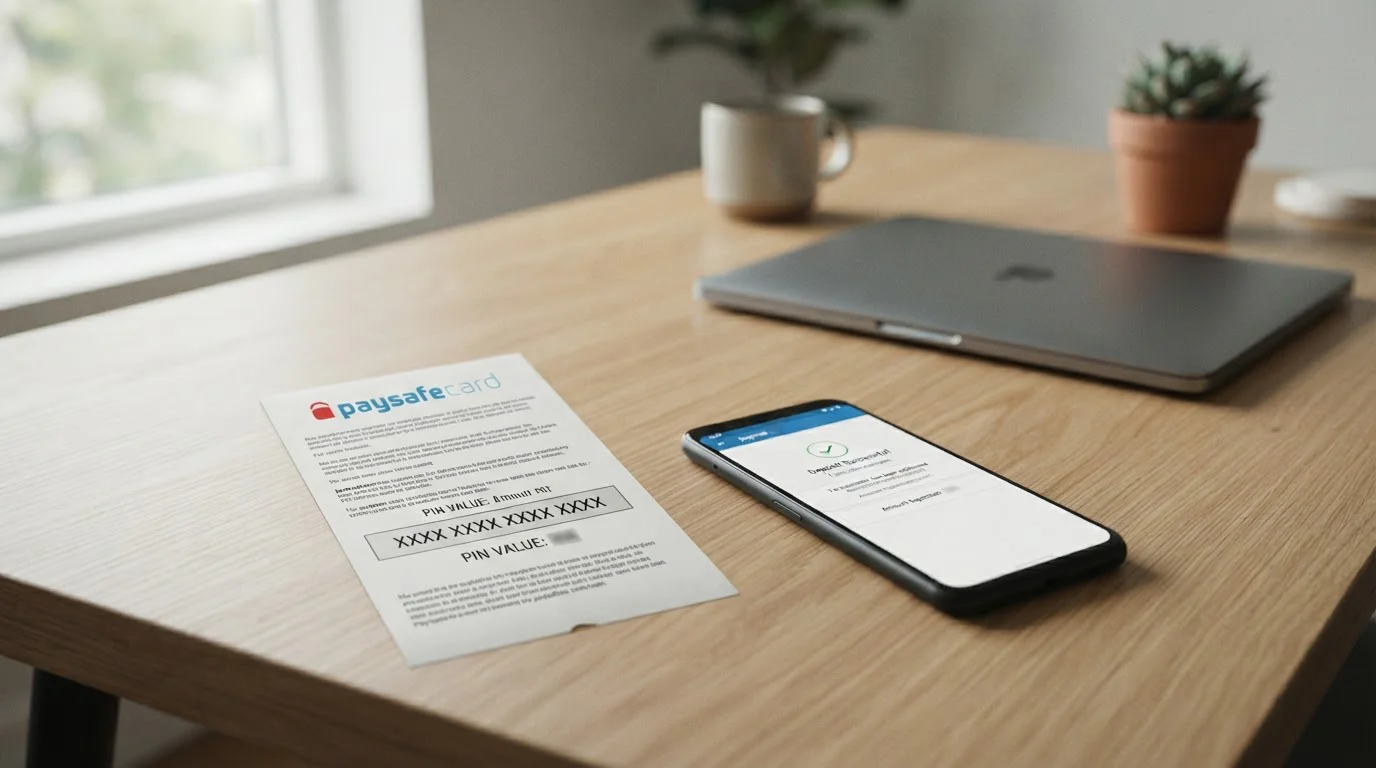
Not every player wants their casino transactions linked to a bank account or debit card. Some value anonymity. Others want strict spending control. Still others operate in cash economies or distrust mainstream financial institutions. Prepaid vouchers and alternative payment methods serve those edges.
The catch is functionality. Prepaid methods are almost always deposit-only. Winnings must exit via another route. Availability is spottier than debit cards or e-wallets. Fees and minimums are higher. But for players whose priorities sit outside the mainstream, these methods fill gaps the big players do not.
Paysafecard
Paysafe Prepaid Services Limited, owned by Paysafe Group, operates Paysafecard as a prepaid voucher system. You buy a voucher at a retail location—Tesco, PayPoint outlets, WH Smith, Morrisons, thousands of locations across the UK—or online via the Paysafecard website. The voucher carries a 16-digit code worth £25, £50, £75, £100, £125, or £150. You enter that code at the casino cashier. Funds transfer from the voucher to your casino balance. No bank account, no card details, no online banking. Cash to voucher to casino.
Paysafecard is FCA-regulated under an e-money license. It is legitimate, long-established (founded 2000), and widely accepted at UK-facing casinos. Not every operator supports it, but enough do that finding a Paysafecard-friendly casino is straightforward.
The deposit is immediate. Enter the 16-digit PIN and the voucher balance transfers to your casino account. You can combine multiple vouchers if your deposit exceeds one voucher’s value. Registered Paysafecard accounts (free to create) let you consolidate voucher codes into a single balance and support higher transaction limits.
It’s deposit-only, so there’s no cashing out to a voucher. Winnings must exit via debit card, e-wallet, or bank transfer. That means your first Paysafecard deposit at a casino is anonymous, but the moment you request a withdrawal, you must verify your identity and provide a bank-linked payment method. The anonymity is one-way.
Fees to the player are minimal. You pay face value for the voucher at the point of purchase. Some retailers may charge a small service fee (£1–£2), but Paysafecard itself does not add fees at the deposit stage. Dormancy fees apply if your Paysafecard account sits unused for 12 months, but for active users, costs are negligible.
Minimum deposits are set by the voucher denomination—£25 is the smallest voucher available, so £25 is the effective minimum. That is higher than debit cards (£5–£10) or e-wallets (£10).
Bonus treatment varies. Some UK casinos exclude Paysafecard from welcome bonuses, reasoning that prepaid methods enable bonus abuse; others allow it. Check the terms.
Paysafecard’s use case is spending control and anonymity. A player who wants to limit their gambling spend to £50 per month buys two £25 vouchers, uses them, and stops. No chasing losses with a card you can reuse. No temptation to “just deposit £20 more.” Once the voucher is spent, it is gone.
The anonymity angle is weaker than it appears. Yes, you can buy a voucher with cash and deposit without linking a bank account. But UKGC-licensed casinos must verify your identity before paying out winnings. The moment you request a withdrawal, KYC kicks in. Name, address, proof of identity, source of funds—standard checks apply. Paysafecard delays identity verification until withdrawal, it does not eliminate it.
GamStop integration applies. UKGC operators cross-check Paysafecard transactions against the GamStop self-exclusion register. If you are registered with GamStop, Paysafecard deposits at UK-licensed casinos are blocked.
Userguide.WordAndBrown reported that over 650,000 UK players used prepaid cards (Paysafecard being the dominant one) for online gambling in 2025. The figure indicates sustained demand for prepaid methods despite their limitations.
MuchBetter
MuchBetter, covered in detail under E-Wallets, also functions as a prepaid alternative. You fund your MuchBetter balance via debit card or bank transfer, then use that balance at casinos. It combines e-wallet speed with prepaid separation from your main bank account. Refer to the MuchBetter breakdown in the E-Wallets section for full details.
Klarna, Zimpler, Jeton — Limited UK Availability
Three alternative payment providers come up in searches for UK casino payments in 2026, but each has limited viability.
Klarna Bank AB, the Swedish buy-now-pay-later giant, is rarely accepted at UK-licensed casinos. Klarna’s core product is instalment-based purchasing—buy now, pay in 30 days or split across multiple payments. That model conflicts with UKGC’s responsible gambling stance against gambling with borrowed money. The credit card ban of 2020 stemmed from the same logic. Casinos that do support Klarna see minimal uptake because the BNPL model feels uncomfortably close to credit-based gambling, which UK players associate with harm. Klarna is FCA-registered and legitimate, but UK casino adoption is sparse.
Zimpler AB, another Swedish fintech founded in 2012, offers instant bank transfer with built-in spending limits. Zimpler is popular at Pay N Play casinos in Nordic markets, where it competes directly with Trustly. In the UK, Zimpler’s presence is niche. Some operators support it, but it has not gained the traction Trustly has. Zimpler’s FCA registration is current, so it meets regulatory standards, but availability at mainstream UK casinos is limited. For players who encounter Zimpler as an option, it functions like Trustly—instant bank transfer, Open Banking integration, zero fees. It is simply less common.
Jeton Wallet, founded in 2017 and FCA-licensed, is a multi-currency e-wallet with both an account-based wallet and a prepaid voucher option (JetonCash). Jeton has stronger penetration in Asian and Eastern European markets than in the UK. A handful of UK-facing casinos accept it, but it remains marginal. Jeton’s distinguishing feature is multi-currency support—useful for players who gamble across different regions or currencies, less relevant for UK players transacting exclusively in GBP. Jeton costs nothing for GBP deposits at supported casinos. Processing speed mirrors other e-wallets—instant deposits, 24–48 hour withdrawals. Bonus eligibility varies by operator.
None of these three—Klarna, Zimpler, Jeton—are recommended as primary payment methods for UK players in 2026. If a casino lists one and you already have an account, they work. If you are choosing a payment method from scratch, debit cards, e-wallets (PayPal, Skrill, MuchBetter), Trustly, or mobile payments are more widely supported and better understood.
Cryptocurrency — Offshore Only
Bitcoin, Ethereum, Litecoin, Dogecoin, and other cryptocurrencies are not viable payment methods at UKGC-licensed casinos. The UK Gambling Commission does not permit licensed operators to accept cryptocurrency deposits or pay out in crypto. The regulatory barrier is absolute.
Crypto casinos exist. They operate under offshore licenses—Malta Gaming Authority, Curaçao eGaming, others—and accept UK players. But they are not UKGC-licensed. That means no UK regulatory protections, no recourse to the Gambling Commission if a dispute arises, no GamStop integration, no mandatory KYC before play.
For UK players who want UKGC-licensed gambling with crypto, the answer is: you cannot have both. Pick licensed gambling and use fiat payment methods. Or pick crypto and use offshore casinos. The two do not intersect in the UK regulated market as of 2026.
Offshore crypto casinos advertise no-KYC gambling, instant deposits and withdrawals, and access to provably fair games. Those features appeal to privacy-focused players. The cost is zero consumer protection. If the casino refuses to pay out, freezes your account, or disappears overnight, you have no regulatory body to complain to.
Only UKGC-licensed operators are included here. Cryptocurrency is mentioned only for completeness—it is not a recommended payment method for UK players who value legal protections.
Can I withdraw to Paysafecard at UK casinos?
No. Paysafecard is deposit-only. You can buy a voucher and use it to deposit, but UK casinos cannot pay winnings back to a Paysafecard voucher. Withdrawals must be made via debit card, e-wallet (PayPal, Skrill, Neteller, MuchBetter), or bank transfer. The first withdrawal triggers identity verification, which requires linking a bank-based payment method.
Withdrawal Speed, Fees and Limits — The Numbers That Matter

Processing times, transaction fees, and deposit minimums shape the real-world experience of moving money. Published windows tell part of the story. Real-world medians tell the rest. A casino that claims “24-hour withdrawals” may deliver in 18 hours or 46 hours depending on the method, the time of day you request, and whether weekends fall in the window.
The table below ranks methods by actual tested withdrawal speed, not marketing copy.
| Payment Method | Median Real-World Withdrawal Speed | Published Window | Notes |
|---|---|---|---|
| PayPal | 12–18 hours | 24–48 hours | Fastest e-wallet in practice; often same-day if requested early |
| Skrill | 18–24 hours | 24–48 hours | Slightly slower than PayPal but still sub-24h at fast casinos |
| Neteller | 18–24 hours | 24–48 hours | Identical to Skrill; same parent company, same processing |
| MuchBetter | 24 hours | 24–48 hours | Matches other e-wallets; sometimes slower due to lower adoption |
| Trustly / Open Banking | 1–4 hours (best casinos) / 24–48 hours (typical) | 24–48 hours | Sub-hour possible at fast operators like PlayOJO; most take longer |
| Debit Card (Visa/Mastercard) | 2–3 working days | 1–3 working days | Faster casinos manage 24–48 hours; weekend requests add delay |
| Standard Bank Transfer | 3–5 working days | 1–5 working days | Slowest option; universally available fallback |
| Apple Pay / Google Pay | Not supported | N/A | Deposit-only; withdrawals require another method |
| Pay by Mobile (Boku) | Not supported | N/A | Deposit-only; withdrawals require another method |
| Paysafecard | Not supported | N/A | Deposit-only; withdrawals require another method |
The “published window” is what the casino lists in its terms. The “median real-world speed” is what tested withdrawals actually delivered across fast-paying UK operators in 2026. The gap between the two is where player experience diverges from marketing.
PayPal consistently outperforms its published window. Request a PayPal withdrawal at 10am on a Tuesday, expect it in your PayPal balance by Wednesday morning. Skrill and Neteller lag slightly behind but still beat debit cards.
Trustly has the widest variance. At casinos that prioritize fast payouts (PlayOJO, Casumo, others), Trustly withdrawals clear in under an hour. At casinos with slower finance teams, Trustly takes 24 to 48 hours, matching e-wallets. The technology supports speed; not every operator uses it.
Debit cards are predictable. Two to three working days is the norm. Weekend requests often push into the next week. A withdrawal requested Friday evening may not land until Tuesday or Wednesday.
Fees break down clearly:
- Zero to player: Visa/Mastercard debit (GBP), Apple Pay, Google Pay, pay by mobile (mostly), Trustly, PayPal (GBP), MuchBetter (GBP), standard bank transfer (at casino side; your bank may charge), Paysafecard (voucher purchase only).
- Player-facing fees: Skrill 1.45% currency conversion + £1 instant withdrawal to bank; Neteller 1.50% currency conversion.
- Casino-absorbed: Trustly ~0.8% per transaction (casino pays, not player).
For UK players transacting exclusively in GBP, most methods cost nothing. Currency conversion fees only bite when depositing in EUR, USD, or other non-GBP currencies. Skrill and Neteller’s FX margins are the exception—they charge even within the same currency zone if your account and the casino operate in different base currencies.
Deposit minimums:
- £1–£5: Some debit card casinos, some Open Banking operators.
- £5–£10: Most debit card casinos, Apple Pay, Google Pay.
- £10–£20: E-wallets (PayPal, Skrill, Neteller, MuchBetter), Trustly, pay by mobile.
- £25: Paysafecard (smallest voucher denomination).
Budget-conscious players chasing £1 or £5 minimum deposits will find them at select debit card casinos. Most operators set £10 as the standard floor across all methods.
Withdrawal limits are operator-specific, not method-specific. High rollers face caps like £10,000 to £100,000 per transaction depending on the casino and their VIP status. Standard players see lower limits, often £2,000 to £5,000 per withdrawal. Monthly caps apply at some casinos. Check the terms if you are withdrawing large sums.
Which payment method offers the fastest withdrawals at UK casinos?
PayPal offers the fastest withdrawals at UK casinos, with median real-world speeds of 12 to 18 hours—often same-day if requested early. Skrill and Neteller follow closely at 18 to 24 hours. Trustly can match or beat e-wallets at fast-paying casinos (under 1 hour at PlayOJO), but most operators process Trustly in 24 to 48 hours. Debit cards take 2 to 3 working days. Standard bank transfers take 3 to 5 days.
How to Pick the Right Payment Method for Your Priorities

No single payment method wins every category. PayPal is fastest but locks you out of bonuses. Debit cards qualify for bonuses but withdraw slower. Trustly offers zero fees and bonus eligibility but is not universally accepted. Paysafecard delivers anonymity but is deposit-only. Every choice sacrifices something.
Decision Framework: Speed, Bonus, Cost, Anonymity
Identify your top priority. Pick the method that delivers it.
| Your Priority | Recommended Method | Why |
|---|---|---|
| Fastest withdrawals | PayPal, Skrill, or Neteller | E-wallets clear in 12–24 hours; PayPal is fastest in practice (12–18h median) |
| Welcome bonus access | Visa/Mastercard debit, Apple Pay, Google Pay, Trustly | E-wallets are excluded at 80% of casinos; debit and mobile pay almost always qualify |
| Zero fees (deposits and withdrawals) | Debit card (GBP), Trustly, Apple Pay, Google Pay | Skrill and Neteller charge FX fees and instant withdrawal fees; debit and Trustly cost nothing |
| One-tap convenience | Apple Pay (iOS) or Google Pay (Android) | Fastest deposit experience; deposit-only, so pair with e-wallet or debit for withdrawals |
| Anonymity / no bank link | Paysafecard | Cash-to-voucher workflow keeps deposits off bank statements; withdrawal triggers KYC |
| Strict spending control | Pay by mobile (Boku) or Paysafecard | Boku caps deposits at £30–£240/month; Paysafecard limits you to purchased voucher values |
| Instant registration (no username/password) | Trustly (Pay N Play casinos) | Bank login verifies identity; deposit and play immediately without filling forms |
| Widest casino acceptance | Visa or Mastercard debit | Accepted at 100% of UKGC-licensed casinos; every other method has gaps |
If you are a new player claiming a welcome bonus, deposit with a debit card, Apple Pay, Google Pay, or Trustly. Do not use PayPal, Skrill, Neteller, or MuchBetter—you will forfeit the bonus at 80% of casinos.
If you are a returning player who values withdrawal speed over bonuses, switch to PayPal, Skrill, or Neteller. The 12–24 hour cashout window beats debit cards by 1–2 days. The bonus exclusion no longer matters because you already cleared the welcome offer months ago.
If you want zero fees and bonus access, use a debit card or Trustly. Both cost nothing, both qualify for bonuses, both are widely accepted. Trustly withdraws faster than debit at the best casinos. Debit cards work at every casino without exception.
If you value privacy, buy Paysafecard vouchers with cash. Deposit without linking a bank account. Understand that the first withdrawal triggers identity verification, so anonymity is temporary. GamStop integration means self-excluded players cannot bypass blocks with Paysafecard.
If you want to limit your gambling spend externally, use pay by mobile (Boku). Network-enforced caps of £30 to £240 per month make it impossible to chase losses beyond that limit. No willpower required—the system blocks deposits once you hit the cap.
Depositing at a UK Casino
Depositing follows a consistent sequence. Log in to your casino account and open the cashier or deposit section, then select your payment method from the options listed—debit card, e-wallets, mobile pay, bank transfer or prepaid vouchers. Enter the deposit amount, checking the minimum first (typically £5–£10 for debit, £10–£20 for e-wallets, £25 for Paysafecard). Next comes authentication: for debit cards you enter the card details and complete 3D Secure (an SMS code or bank-app confirmation); for e-wallets you log in to PayPal, Skrill or Neteller and approve; for Apple Pay or Google Pay you authenticate with Face ID or a fingerprint; for Trustly you pick your bank and log in with your online banking credentials; for pay by mobile you enter your phone number and confirm by SMS; and for Paysafecard you enter the 16-digit voucher code. Funds then appear almost immediately—debit, e-wallet, mobile pay, Trustly and Paysafecard deposits clear in seconds, while standard bank transfers take one to five days. Once the deposit is credited to your balance you can start playing, and any bonus you claimed is added automatically where your payment method qualifies.
Withdrawing Your Winnings
Withdrawing works much the same way. Head to the cashier and select withdrawal or cashout, then choose your withdrawal method from the options listed—note that for deposit-only methods (Apple Pay, Google Pay, pay by mobile, Paysafecard) you must nominate a different route such as a debit card, e-wallet or bank transfer. Enter the amount, checking the minimum withdrawal (often £10–£20) and the maximum per transaction (operator-specific, typically £2,000–£10,000 for standard players). On your first withdrawal you will need to pass KYC: UKGC operators require proof of identity (passport or driving licence), proof of address (utility bill or bank statement) and sometimes proof of payment method (a photo of your debit card with the middle digits obscured), which takes 24–72 hours; later withdrawals skip this step unless the operator flags your account for extra checks. The casino then processes the request—fast operators within hours, slower ones in 24–48 hours before releasing payment, and pending withdrawals can usually be cancelled if you change your mind. Finally the funds reach you: 12–24 hours after processing for e-wallets (PayPal, Skrill, Neteller), 1–48 hours for Trustly, two to three working days for debit cards and three to five working days for a standard bank transfer.
Weekend requests add delay. A withdrawal requested Friday evening often does not start processing until Monday morning, then follows the standard timeline from there.
Wagering requirements must be cleared before withdrawal. If you claimed a bonus, you must play through the bonus amount multiplied by the wagering requirement (e.g., £20 bonus with 35x wagering = £700 total bets required) before cashing out. The casino’s cashier shows your progress. Attempting to withdraw before meeting wagering forfeits the bonus and any winnings derived from it.
Pick Your Trade-Off — Speed, Bonuses, or Control
UK casino payments in 2026 boil down to trade-offs. Speed or bonuses. Convenience or functionality. Anonymity or withdrawals. You optimize for one dimension at the cost of another.
Debit cards remain the universal default—accepted everywhere, bonus-friendly, zero fees, predictable 2–3 day withdrawals. They are the safe choice when nothing else fits.
E-wallets own the speed race—PayPal, Skrill, Neteller clear withdrawals in 12–24 hours, faster than any card or bank transfer. The price is bonus exclusion at 80% of casinos. For returning players, e-wallets are superior. For new players, e-wallets cost them the welcome offer.
Mobile payments (Apple Pay, Google Pay, Boku) strip deposits down to one tap, but none support withdrawals. They are partial solutions.
Trustly and Open Banking combine speed, zero fees, and bonus eligibility. Sub-hour withdrawals are possible at the best casinos. Trustly is the overlooked winner for players who want debit card eligibility with e-wallet speed.
Paysafecard delivers anonymity and spending control at the cost of deposit-only functionality. First withdrawal triggers KYC. Anonymity is temporary.
Pick the method that fits your priorities. Ignore the method that optimizes for someone else’s. The best payment option is the one that solves the problem you actually have—not the one that wins a speed test you will never notice or preserves a bonus you will never claim.
Casino Deposit Methods UK 2026 — Compare Payment Options
Content created by the «casinopayexp» team