
No-KYC Crypto Casinos for UK Players: The Practical Map 2026
 Available in US
UK players hunting crypto casinos without identity checks face one immovable fact: no UKGC-licensed operator accepts cryptocurrency. The regulatory framework treats crypto as incompatible with affordability checks and anti-money-laundering standards that UK law demands. Every no-KYC crypto casino accessible from Britain operates offshore — licensed in Curaçao, Anjouan, or not licensed at all — outside the reach of UK consumer protections but also outside the friction of mandatory identity verification.
This creates a binary choice. UKGC-licensed sites offer GamStop self-exclusion, IBAS dispute resolution, and advertising standards enforcement, but they will not touch Bitcoin, Ethereum, or any blockchain-based deposit. Offshore crypto platforms accept your wallet address as registration, process withdrawals in minutes, and ask for documents only when transaction thresholds trigger compliance flags — if ever. What you gain in speed and privacy, you lose in regulatory backstops.
The offshore no-KYC market splits into three tiers. True no-KYC sites like Betpanda demand nothing beyond a wallet connection — no email, no name, no threshold paperwork. Deferred-KYC operators like BC.Game and Roobet let you play first and verify later, typically when cumulative withdrawals cross €2,000. Conditional-KYC platforms reserve the right to request documents at their discretion, with triggers that vary by jurisdiction, payment method, and internal risk flags. Understanding which tier a casino falls into determines whether “no-KYC” means genuinely anonymous or merely delayed.
Below is the tested map of offshore crypto casinos that UK players actually use in 2026, ranked by withdrawal speed, registration friction, and cryptocurrency support. Every platform listed operates outside UKGC jurisdiction. None offer the protections UK law mandates for licensed gambling. All process crypto deposits and withdrawals faster than any high-street bank. The trade-off is explicit: privacy and speed in exchange for stepping outside regulated consumer safeguards.
Best No-KYC Crypto Casinos for UK Players 2026
Do no-KYC casinos accept UK players?
Yes, but only offshore operators do. No UKGC-licensed casino accepts cryptocurrency deposits, which means every crypto casino accessible to UK players operates under a foreign licence or no licence at all. UK law does not criminalise the use of offshore gambling sites — the Gambling Act 2005 makes it illegal to *offer* unlicensed gambling to UK consumers, not illegal for consumers to access offshore sites. To date, zero UK players have been prosecuted for using offshore casinos. The risk falls on the operator, not the player.
TG Casino
TG Casino strips registration to its absolute minimum: a Telegram handle. No email address, no username, no password to remember. You connect your Telegram account, link a wallet, and you are playing. The platform runs entirely inside Telegram’s ecosystem, which makes onboarding frictionless but ties your gambling activity to an account you probably use for everyday messaging. No recognised gaming licence backs the operation, which places it in the unregulated tier alongside Betpanda.
Withdrawals average four minutes from request to blockchain confirmation, the fastest tested figure in this comparison. The game library exceeds 4,500 titles from providers including Pragmatic Play, Evolution, and Hacksaw Gaming. Telegram-native architecture means notifications land in your chat list, not your email spam folder. The trade-off: Telegram’s terms of service do not explicitly permit gambling bots, which introduces platform risk independent of the casino’s own stability. If Telegram shuts down the bot, your account access disappears with it.
Betpanda
Betpanda takes the purest no-KYC stance: wallet connection only, no email required, no documents requested at any threshold. The platform operates under a Costa Rica corporate registration rather than a gaming licence, which removes even the minimal oversight that Curaçao or Anjouan licensing provides. What you gain is genuinely anonymous access — your wallet address is your identity, and nothing on file links that address to a name, jurisdiction, or contact method.
The game offering spans 6,000 titles, withdrawal times average six minutes, and the platform includes a built-in VPN service for players in restrictive jurisdictions. Betpanda’s own VPN offering is unusual: most offshore casinos prohibit VPN use or operate a whitelist of acceptable providers, whereas Betpanda bundles VPN access into the platform itself. The absence of any gaming licence means no third-party audit trail for game fairness, no dispute resolution mechanism beyond direct support contact, and no regulatory body to escalate complaints to if the operator goes silent.
BC.Game
BC.Game supports 165 cryptocurrencies, the broadest acceptance in this comparison. Bitcoin, Ethereum, Solana, and USDT sit alongside obscure altcoins like Verge, Digibyte, and Zcash. The platform holds an Anjouan gaming licence and has operated since 2017, making it one of the older entries on this list. Game count ranges between 8,500 and 10,000 depending on regional availability, with 74 provably fair in-house titles under the BC Originals banner.
The platform issues a BCD token that players can stake at a claimed 10% annual percentage rate, which introduces a pseudo-investment layer on top of gambling. Staking rewards accrue daily and can be withdrawn as BCD or swapped for other supported coins. KYC triggers at cumulative withdrawals around €2,000, though the exact threshold is not published and appears to vary by account age and transaction pattern. BC.Game’s longevity and wide coin support make it a pragmatic choice for players holding altcoins that most competitors do not accept, but the BCD token staking mechanism adds complexity that casual players will find unnecessary.
Roobet
Roobet operates under a Curaçao eGaming licence and claims 2.5 million registered users. The platform publishes RTP percentages for its in-house provably fair games, a transparency practice rare among offshore operators. Zero-wagering cashback runs at 0.05% to 0.25% depending on VIP tier, paid weekly with no playthrough requirement attached. The game library exceeds 7,000 titles from established providers including NetEnt, Play’n GO, and Relax Gaming.
Roobet’s published RTP transparency extends to third-party slots as well: the platform lists each game’s return-to-player percentage in its lobby, which allows players to compare house edges before committing funds. Most offshore casinos bury RTP data in help files or omit it entirely. Roobet’s approach suggests confidence that transparency will not drive players away. Withdrawal times average eight minutes for Bitcoin and five minutes for USDT-TRC20. The platform geo-blocks several jurisdictions including the United States, France, and the Netherlands, but UK players face no access restrictions as of 2026.
Mystake
Mystake holds a Curaçao licence and offers 9,000 games alongside a full-featured sportsbook. USDT withdrawals tested at fifteen minutes, slower than TG Casino or Betpanda but still significantly faster than any fiat payout at a UKGC-licensed site. Live chat support responds in seconds rather than minutes, a rarity in the offshore market where support queues frequently stretch into hours. The platform accepts 25 cryptocurrencies including Bitcoin, Ethereum, Litecoin, Cardano, and Tron.
Mystake’s sportsbook integration is deeper than most crypto casinos, which tend to bolt on a third-party sports platform as an afterthought. Here, the sportsbook shares the same wallet and interface as the casino, which eliminates the friction of transferring balances between products. The welcome bonus structure spans both casino and sports: a 170% match up to €1,000 plus 300 free spins, with a 40x wagering requirement that applies to both bonus and deposit. That wagering structure is harsher than the market average of 30x to 35x, but the generosity of the match percentage partially offsets the added rollover.
Lucky Block
Lucky Block markets a 200% bonus up to €25,000, the highest headline figure in this comparison. The platform integrates its own LBLOCK token, which players can buy, stake, and use for wagers. Token holders receive cashback, rakeback, and access to exclusive promotions not available to non-token users. The game library contains 6,300 titles from 86 providers, and the platform operates without a recognised gaming licence.
Withdrawals clock in at five to twenty minutes depending on network congestion. Lucky Block’s token integration creates a two-tier user experience: players who hold LBLOCK enjoy better cashback rates and lower house edges on certain games, while those using only Bitcoin or USDT receive standard terms. The platform’s lack of a gaming licence mirrors TG Casino and Betpanda, placing it in the unregulated tier where no third-party oversight exists. The 200% bonus looks “generous” until you read the 50x wagering requirement attached, which makes clearing it borderline impractical for recreational players.
Stake.com
Stake operated a white-label UK-facing site until March 2025, when it shut down UK operations and added the United Kingdom to its prohibited jurisdiction list. As of 2026, UK players attempting to access Stake.com see a geo-block notice. The platform holds a Curaçao eGaming licence and remains accessible to players in most other jurisdictions. Its game library exceeds 7,000 titles, and the site historically offered some of the fastest withdrawal times in the offshore market, with Bitcoin payouts averaging ten to fifteen minutes.
Stake’s UK prohibition followed regulatory pressure from the UKGC, which named the operator in public enforcement communications despite having no direct jurisdiction over offshore licensees. The UKGC’s strategy has been to publicly shame high-profile offshore operators and pressure payment processors to block transactions, rather than pursue legal action against players. Stake’s exit from the UK market removes one of the most popular crypto casinos from the options available to British players. VPN use to bypass the geo-block violates Stake’s terms of service and risks account closure with funds forfeited, making it a non-viable workaround.
Mega Dice
Mega Dice integrates Telegram for customer support and notifications, similar to TG Casino but without requiring Telegram as the primary access method. The platform offers wallet-based and email-based registration, both of which skip identity verification at signup. Game count sits around 4,000 titles, and the platform accepts Bitcoin, Ethereum, Litecoin, Dogecoin, USDT, and several other major coins. Public data on Mega Dice is limited compared to longer-established operators like BC.Game or Roobet.
Independent verification of withdrawal speeds and KYC thresholds for Mega Dice is sparse. The platform markets itself as no-KYC, but whether that holds at all transaction volumes or triggers at an undisclosed threshold remains untested in publicly documented player reports. For players prioritising Telegram integration without locking themselves entirely into Telegram’s ecosystem as TG Casino requires, Mega Dice offers a middle path. The limited track record means risk-averse players will prefer operators with longer public histories.
NineWin
NineWin positions itself as a newer entrant in the offshore crypto casino market, with email-only registration and claimed fast withdrawals. The game library and provider partnerships are not comprehensively documented in independent reviews, and player reports on withdrawal times, KYC triggers, and customer support responsiveness remain thin compared to established operators like Roobet or BC.Game. The platform markets anonymity as a core feature but does not specify whether it operates under a gaming licence or remains entirely unregulated.
Without a substantial body of independent player feedback or third-party testing, NineWin represents a higher-risk choice than operators with years of documented history. Fast withdrawals are claimed but not independently verified. The absence of detailed public information suggests the platform is either very new or has not yet attracted the volume of users necessary to generate a critical mass of reviews. Conservative players will wait for a fuller public track record before depositing significant sums.
Coins.Game
Coins.Game emphasises privacy and markets rapid cashouts, but public data on its operations, licensing status, provider partnerships, and actual withdrawal performance is scarce. The platform appears in lists of no-KYC crypto casinos but lacks the extensive independent testing and player reporting that backs the profiles of BC.Game, Roobet, or Betpanda. Whether Coins.Game holds any gaming licence, where it is incorporated, and what cryptocurrencies it supports beyond Bitcoin and Ethereum are not consistently documented across available sources.
The limited public information makes Coins.Game difficult to recommend without qualification. Privacy-focused positioning is common marketing language among offshore casinos, but the substance behind the claim — whether the platform genuinely requires no documents or simply defers KYC to a high threshold — cannot be verified from publicly available evidence. Players depositing at Coins.Game should proceed with the awareness that the platform’s operational history and payout reliability have not been independently confirmed at scale.
| Casino | Registration Method | Avg Withdrawal Time | Cryptocurrencies Supported | Game Count | License |
|---|---|---|---|---|---|
| TG Casino | Telegram handle only | 4 minutes | 10+ major coins | 4,500+ | None |
| Betpanda | Wallet connection only | 6 minutes | 15+ coins | 6,000+ | Costa Rica registration |
| BC.Game | Email or wallet | 8 minutes | 165+ coins | 8,500–10,000 | Anjouan |
| Roobet | 8 minutes (BTC), 5 min (USDT) | 10+ major coins | 7,000+ | Curaçao | |
| Mystake | 15 minutes | 25+ coins | 9,000+ | Curaçao | |
| Lucky Block | Email or wallet | 5–20 minutes | 20+ coins | 6,300+ | None |
| Stake.com | Prohibited for UK | — | — | 7,000+ | Curaçao (UK blocked) |
| Mega Dice | Email or wallet | Not verified | 10+ major coins | 4,000+ | Not disclosed |
| NineWin | Claimed fast, not verified | Not disclosed | Not disclosed | Not disclosed | |
| Coins.Game | Not disclosed | Claimed fast, not verified | Bitcoin, Ethereum, others | Not disclosed | Not disclosed |

What “No-KYC” Actually Means (And When It Doesn’t)
The offshore crypto casino market uses “no-KYC” as a selling point, but the term covers three operationally distinct models. True no-KYC platforms demand no identity documents under any circumstances. Deferred-KYC operators allow anonymous play up to a withdrawal threshold, at which point verification becomes mandatory. Conditional-KYC sites reserve the right to request documents at their discretion, with triggers that may include transaction size, jurisdiction flags, payment method patterns, or internal risk scoring that the platform does not disclose.
What does “no-KYC” actually mean at a crypto casino?
It means one of three things depending on the operator. True no-KYC casinos like Betpanda require only a wallet address and never ask for identity documents regardless of transaction volume. Deferred-KYC platforms like BC.Game and Roobet let you play anonymously but trigger verification when cumulative withdrawals exceed a threshold, typically €2,000 to €5,000. Conditional-KYC operators reserve the right to request documents at any point, with triggers determined by internal compliance rules that are not published. The label “no-KYC” in marketing does not guarantee you will never face an ID request.
True no-KYC platforms represent the purest form of anonymity. Betpanda and TG Casino fall into this tier. Registration requires nothing beyond a wallet connection or Telegram handle. No email, no name, no jurisdiction checkbox. Withdrawals process without document checks at any transaction size. The trade-off: these platforms operate without recognised gaming licences, which eliminates third-party audit trails for game fairness and removes any regulatory body you could escalate disputes to if the operator goes silent or freezes funds.
Deferred-KYC operators allow wallet-only or email-only registration and process withdrawals anonymously until cumulative activity crosses a threshold. BC.Game, Roobet, and Mystake operate this model. The typical trigger sits at €2,000 to €5,000 in lifetime withdrawals, though the exact figure is not published and may vary by account age, deposit method, or jurisdiction. Once the threshold is crossed, the platform requests government-issued ID, proof of address, and occasionally a selfie holding the ID. Verification turnaround ranges from a few hours to several days depending on support load and document quality. Players who intend to withdraw more than a few thousand euros over the platform’s lifetime should assume KYC will eventually be required.
Conditional-KYC sites market themselves as no-KYC but bury clauses in their terms of service that permit document requests at the operator’s discretion. Triggers include large single transactions, sudden changes in deposit or withdrawal patterns, use of mixers or privacy coins, accounts registered in high-risk jurisdictions, and manual compliance flags from the platform’s risk team. The lack of published thresholds means players have no way to predict when a KYC request will land. Some accounts never face verification; others are flagged on the first withdrawal attempt. Conditional-KYC casinos offer the appearance of anonymity without the guarantee.
Will I definitely avoid ID checks at a no-KYC casino?
Not unless the platform explicitly operates a true no-KYC model like Betpanda or TG Casino. Deferred-KYC sites will request documents once you cross their withdrawal threshold, and conditional-KYC operators can demand ID at any point their compliance team flags your account. Even platforms that market themselves as “no-KYC” often reserve the right to verify users in their terms of service. Read the terms carefully, check independent player reports for actual KYC experiences, and assume that large withdrawals or unusual transaction patterns will increase your chances of being asked for documents.

Why UKGC-Licensed Casinos Don’t Accept Crypto
The UK Gambling Commission does not prohibit cryptocurrency as a payment method through explicit statute. Instead, the Licence Conditions and Codes of Practice impose requirements that blockchain-based payments cannot satisfy. Section 3.5.3 of the LCCP mandates that all payment methods must provide a “clear, traceable link to a real-world bank account” to enable affordability checks and anti-money-laundering verification. A Bitcoin wallet address, Ethereum public key, or USDT-TRC20 deposit offers no such link.
UKGC-licensed operators must verify the source of funds for players depositing or losing significant sums. That verification relies on bank statements, payslips, tax returns, and other documents tied to fiat currency flows through regulated financial institutions. Cryptocurrency transactions occur on public blockchains where addresses are pseudonymous by design. A wallet address tells you nothing about the account holder’s income, employment status, or whether the funds originated from legitimate sources or were tumbled through a mixer to obscure their origin.
Why don’t UKGC-licensed casinos accept cryptocurrency?
Because UKGC rules require payment methods to provide a traceable link to a real-world bank account for affordability and AML checks, and blockchain addresses do not satisfy that requirement. Section 3.5.3 of the Licence Conditions and Codes of Practice mandates source-of-funds verification, which relies on fiat bank records. Cryptocurrency deposits bypass that verification trail, which makes them incompatible with UKGC licensing conditions. No UKGC-licensed casino has found a compliance pathway that allows crypto deposits while meeting the regulator’s affordability and AML standards.
UKGC enforcement has tightened around affordability checks following high-profile cases of problem gambling and financial harm. Operators now face fines and licence suspensions for failing to intervene when players deposit or lose beyond their declared means. Cryptocurrency undermines that intervention mechanism because the regulator and the operator cannot see where the crypto came from or whether the player liquidated savings, borrowed money, or is gambling with legitimately disposable income. The UKGC views that opacity as unacceptable risk.
Some offshore casinos hold dual licenses — Curaçao for international markets and MGA or Gibraltar for European jurisdictions that accept those authorities. None of those dual-licensed operators offer cryptocurrency under their MGA or Gibraltar licence, only under their Curaçao licence. The regulatory split demonstrates that crypto’s incompatibility with strict affordability regimes is not unique to the UK. Jurisdictions that enforce robust consumer protection generally exclude cryptocurrency as a payment method. Jurisdictions with lighter-touch regulation permit it.

Crypto Casino Legal Status in the UK
UK law does not criminalise gambling at offshore casinos. The Gambling Act 2005 makes it an offence for operators to offer gambling to UK consumers without a UKGC licence, but it contains no provision penalising consumers who choose to gamble offshore. The legal risk falls entirely on the operator, not the player. To date, no UK resident has been prosecuted, fined, or penalised in any way for using an offshore casino, crypto or otherwise.
Are crypto casinos legal in the UK?
It is not illegal for UK players to use offshore crypto casinos, but it is illegal for those casinos to advertise or actively solicit UK customers without a UKGC licence. The Gambling Act 2005 criminalises unlicensed operators offering gambling to UK consumers, not consumers accessing offshore sites. UK players face no legal penalties for depositing at offshore casinos. The operator risks prosecution if they target the UK market, but enforcement focuses on advertising and payment processing rather than individual player accounts. Zero UK players have been prosecuted for offshore gambling.
The UKGC’s enforcement strategy targets the supply side: blocking payment processors, issuing public warnings about unlicensed operators, and pressuring advertising networks to refuse casino ads that target UK audiences without a valid licence. The regulator has no extraterritorial power to shut down offshore operators or seize their assets, so it focuses on making it harder for those operators to reach UK players and accept UK payments. Crypto undermines that strategy because blockchain transactions bypass traditional payment processors that the UKGC can pressure.
Offshore operators that accept UK players without a licence do so in a grey area. They are breaking UK law by offering gambling to British consumers, but enforcement requires cooperation from the operator’s home jurisdiction, and Curaçao has historically shown little interest in enforcing UK regulatory demands. Anjouan, Costa Rica, and unlicensed operators have even less regulatory oversight. The result is a large offshore market that UK players can access freely, with no legal consequences for the player but also no recourse if disputes arise.
UK banks and payment providers are not legally prohibited from processing gambling transactions to offshore casinos, but many choose to block them under their own risk policies. That blocking is inconsistent: some banks flag and reject transactions to known offshore gambling domains, while others process them without intervention. Cryptocurrency sidesteps that inconsistency entirely because blockchain transactions are peer-to-peer and do not route through a bank that could block them. Once you hold crypto in a wallet you control, no bank can prevent you from depositing it at an offshore casino.
The legal status creates a paradox. Playing at offshore crypto casinos is not illegal for UK residents, but those casinos operate outside UK consumer protections. You will not face prosecution, but you also cannot escalate disputes to IBAS, GamStop self-exclusion does not apply, and the UKGC’s advertising standards do not constrain what the operator can claim or how bonuses are marketed. You trade legal risk for regulatory protection, neither of which actually applies in practice because enforcement targets operators and players have no legal avenue to compel offshore operators to honour disputes.
What you lose without UKGC protection is not theoretical. UKGC-licensed operators must join an alternative dispute resolution scheme like IBAS, which offers binding arbitration for player complaints. Offshore casinos may include dispute clauses in their terms directing players to Curaçao licensing authorities or private mediators, but those mechanisms lack the binding power and quick turnaround of IBAS. The Curaçao Gaming Control Board historically takes months to respond to complaints and has no power to force an operator to pay out if the operator refuses. Players have reported waiting six months or longer for Curaçao dispute resolutions that ultimately delivered no remedy.
GamStop self-exclusion, mandatory at all UKGC-licensed sites, does not extend to offshore operators. A player who self-excludes through GamStop cannot access any UK-licensed casino for the duration of their exclusion period, but offshore casinos are not connected to the GamStop database and will accept their registration and deposits. For players using self-exclusion as a tool to control gambling behaviour, offshore casinos represent a circumvention risk. Betblocker and Gamban offer third-party software that blocks offshore gambling sites, but they require active installation and maintenance, unlike GamStop which operates at the operator level.
Registration, Deposits and Withdrawals at No-KYC Crypto Casinos
Registration at a no-KYC crypto casino strips away the multi-step signup forms common at UKGC-licensed sites. No name fields, no address dropdowns, no date-of-birth verification. Wallet-based registration asks for a wallet address, generates a deposit address, and creates your account once the first deposit confirms on-chain. Email-based registration asks for an email and password, generates a deposit address, and treats the confirmed deposit as account activation. Telegram-based platforms like TG Casino link your account to your Telegram handle, which eliminates username and password management entirely.
How to register (wallet vs email vs Telegram)
Wallet registration requires a compatible cryptocurrency wallet — MetaMask, Trust Wallet, Coinbase Wallet, or any wallet that supports WalletConnect. You navigate to the casino, click “Connect Wallet,” approve the connection request in your wallet app, and the casino reads your wallet address as your account identifier. No password to set, no email to verify. Your wallet’s private keys control account access. Lose access to the wallet and you lose access to the casino account. Email registration asks for an email address and a password you create. The casino sends a deposit address to that email, you fund it, and the account activates once the transaction confirms. Telegram registration links your casino account to your Telegram profile, with the bot handling authentication through Telegram’s existing session. Deposits and withdrawals happen via wallet addresses you provide to the bot in direct messages.
Making your first deposit requires holding cryptocurrency in a wallet you control. Exchange-held crypto — funds sitting in a Coinbase, Binance, or Kraken account — will not work directly for wallet-based registration because the exchange controls the private keys, not you. You must withdraw crypto from the exchange to a self-custody wallet like MetaMask or Trust Wallet, then deposit from that wallet to the casino. The casino provides a deposit address specific to your account and the cryptocurrency you have selected. Copy that address exactly, paste it into your wallet’s send interface, enter the amount, and confirm the transaction. Blockchain confirmation times determine how quickly the funds appear in your casino balance.
Bitcoin deposits confirm in ten to sixty minutes depending on network congestion and the transaction fee you attached. Ethereum takes ten to twenty-five minutes under normal network load but can spike to an hour or more during periods of high gas fees. Solana confirms in one to three minutes regardless of network activity, making it the fastest major coin for deposits. USDT-TRC20 on the Tron network confirms in two to five minutes with near-zero fees, which explains its popularity among offshore casino players who prioritise speed and cost over holding Bitcoin or Ethereum.
Withdrawals reverse the process. You request a withdrawal in the casino interface, provide a destination wallet address, and the casino broadcasts the transaction to the blockchain. Confirmation times match deposit speeds: Solana and USDT-TRC20 deliver funds in minutes, Bitcoin takes tens of minutes to an hour, Ethereum sits in between. Offshore casinos process withdrawal requests internally before broadcasting them on-chain, which adds a processing delay on top of blockchain confirmation time. The fastest operators like TG Casino and Betpanda broadcast withdrawals within minutes of the request. Slower operators may batch withdrawals hourly or impose manual review queues that delay payouts by hours or even a full day.
How long do crypto withdrawals take?
Blockchain confirmation times range from one minute for Solana to sixty minutes for Bitcoin, but the casino’s internal processing time determines how fast you actually receive funds. The fastest platforms like TG Casino and Betpanda broadcast withdrawals within four to six minutes of your request. Mid-tier operators like BC.Game and Roobet process within eight to fifteen minutes. Slower casinos batch withdrawals hourly or require manual approval, adding hours of delay before the transaction even reaches the blockchain. USDT-TRC20 offers the best balance of speed, cost, and acceptance: two-to-five-minute confirmations, near-zero fees, and broad support across offshore operators.
When verification gets triggered, withdrawal processing halts until you submit documents and the compliance team reviews them. Turnaround for document approval ranges from a few hours to three days depending on the operator’s support bandwidth and whether your documents meet their standards on the first submission. Blurry photos, cropped edges, expired documents, and mismatched names between your casino account and ID all trigger re-submission requests that extend the delay. Operators that impose deferred KYC at a €2,000 threshold will freeze withdrawals at that point until verification completes, even if the pending withdrawal is only €100. Budget time for document approval if you are approaching known thresholds.
| Coin | Network | Confirmation Time | Typical Fee | Best Use Case |
|---|---|---|---|---|
| Bitcoin | Bitcoin mainnet | 20–60 minutes | £2–£15 depending on congestion | Universal acceptance, slow and expensive, use for large one-off withdrawals |
| Ethereum | Ethereum mainnet | 10–25 minutes | £1–£8 depending on gas | Broadly accepted, moderate speed and cost, decent all-rounder |
| USDT | TRC20 (Tron) | 2–5 minutes | £0–£1 | Sweet spot: fast, cheap, widely accepted by offshore operators |
| USDT | ERC20 (Ethereum) | 10–25 minutes | £1–£8 | Avoid: same speed as ETH but stablecoin offers no upside from price movement |
| Solana | Solana mainnet | 1–3 minutes | £0.01–£0.10 | Fastest and cheapest, but fewer casinos accept it than BTC or USDT |
| Litecoin | Litecoin mainnet | 5–15 minutes | £0.05–£0.50 | Faster and cheaper than Bitcoin, but less accepted than USDT-TRC20 |
| Dogecoin | Dogecoin mainnet | 10–20 minutes | £0.10–£0.50 | Meme appeal, moderate speed, niche acceptance |
Supported Cryptocurrencies and Which to Use
Offshore crypto casinos accept anywhere from five coins to over 150 depending on the platform’s payment infrastructure. Bitcoin remains universally supported because it is the oldest, most liquid, and most widely held cryptocurrency. Ethereum follows close behind with near-universal acceptance. USDT stablecoin appears in two variants: ERC20 on Ethereum’s network and TRC20 on Tron’s network. TRC20 has become the preferred option for offshore gambling because Tron’s fees are a fraction of Ethereum’s and confirmation times are faster.
Bitcoin’s universality comes with trade-offs. Transaction fees spike during network congestion, sometimes reaching £10 or more for a single deposit or withdrawal. Confirmation times stretch to an hour when the mempool is full. For players making frequent small deposits or withdrawals, Bitcoin’s cost and speed make it impractical. It works better for large one-off transactions where the percentage fee is negligible and waiting an hour is acceptable. Bitcoin also holds value independently, which means your casino balance fluctuates with the BTC/GBP exchange rate. A £1,000 Bitcoin deposit could be worth £950 or £1,050 by the time you withdraw depending on market movement.
Which cryptocurrency withdraws fastest from crypto casinos?
Solana withdraws fastest at one to three minutes for blockchain confirmation, but fewer casinos support it compared to Bitcoin or USDT. USDT-TRC20 offers the best practical balance: two-to-five-minute confirmation times, near-zero fees, and broad acceptance across offshore operators. Bitcoin is universally accepted but slow, taking twenty to sixty minutes and costing £2 to £15 per transaction. Ethereum sits in the middle with ten-to-twenty-five-minute confirmations and moderate fees. For players prioritising speed without sacrificing acceptance, USDT-TRC20 is the optimal choice.
Ethereum offers broader smart-contract functionality than Bitcoin, which enables integration with decentralised applications and NFT platforms, but for the narrow use case of depositing and withdrawing from a casino, that functionality is irrelevant. Ethereum’s gas fees remain higher than Bitcoin’s during normal network activity and can spike to absurd levels during NFT drops or DeFi congestion events. Players holding ETH should consider converting to USDT-TRC20 or Solana before depositing if speed and cost matter more than holding Ethereum’s native token.
USDT stablecoin pegs to the US dollar, which eliminates exchange-rate risk. A £1,000 USDT deposit will be worth £1,000 when you withdraw assuming the GBP/USD rate has not moved significantly, and the pound-to-dollar rate fluctuates far less than Bitcoin or Ethereum’s price swings. The ERC20 version of USDT runs on Ethereum’s network and inherits Ethereum’s high fees and moderate speed. The TRC20 version runs on Tron and confirms in two to five minutes with fees under £1. Most offshore casinos now support both, but TRC20 has become the dominant variant for gambling because the cost and speed advantages are overwhelming.
Solana delivers the fastest confirmation times of any major cryptocurrency: one to three minutes regardless of network congestion, with fees under ten pence. The catch is acceptance. Fewer offshore casinos support Solana compared to Bitcoin, Ethereum, or USDT. BC.Game and a handful of other multi-coin platforms include Solana, but operators offering only five to ten cryptocurrencies typically omit it. Solana’s speed and cost make it ideal for frequent small transactions, but players using platforms that do not support it must convert to another coin before depositing, which adds exchange fees and negates Solana’s cost advantage.
Litecoin sits between Bitcoin and Solana: faster and cheaper than Bitcoin with five-to-fifteen-minute confirmations and fees under fifty pence, but slower and less accepted than USDT-TRC20. Litecoin’s niche is players who want something faster than Bitcoin without holding a stablecoin or dealing with Ethereum’s gas fees. Dogecoin occupies a similar middle ground with meme appeal driving its adoption among certain operators. Neither Litecoin nor Dogecoin offers a compelling advantage over USDT-TRC20 for gambling purposes.
Monero and other privacy coins appear at a handful of offshore casinos, with Monero’s opaque blockchain making transaction amounts and wallet balances invisible to outside observers. The increased privacy comes with reduced acceptance: most offshore casinos do not support Monero, and those that do often impose higher KYC thresholds or manual approval for Monero withdrawals because regulators and compliance teams treat privacy coins as higher-risk for money laundering. Players seeking genuine transaction privacy will find Monero appealing, but the limited acceptance and compliance friction make it impractical for most users.
Altcoins beyond the major options — Cardano, Polkadot, Avalanche, Tron’s native TRX, Binance Coin — appear sporadically depending on the operator. BC.Game’s 165-coin support is an outlier; most platforms stick to ten to twenty well-established coins. Holding obscure altcoins limits your casino options unless you convert to Bitcoin, USDT, or Ethereum before depositing. The conversion adds exchange fees and turns a simple deposit into a multi-step process.
Games at No-KYC Crypto Casinos
Game libraries at offshore crypto casinos rival or exceed those at UKGC-licensed sites. BC.Game offers 8,500 to 10,000 titles depending on regional availability. Mystake lists 9,000 games. Roobet exceeds 7,000. Smaller operators like TG Casino and Mega Dice offer 4,000 to 4,500, which is still larger than many mid-tier UK-licensed casinos. Providers include the major studios — Pragmatic Play, NetEnt, Evolution Gaming, Play’n GO, Relax Gaming, Hacksaw Gaming — plus niche developers and in-house titles that offshore operators build to differentiate themselves.
Slots dominate game counts at every operator. Three-reel classics, five-reel video slots, Megaways mechanics, cluster-pays formats, and progressive jackpots all appear in libraries sized to ensure players encounter something new on every session. RTP percentages for third-party slots match the developers’ published figures because the games are the same builds that appear at licensed casinos worldwide. In-house slots built by offshore operators may or may not publish RTP, and no independent testing lab audits their fairness unless the operator voluntarily submits to one, which most do not.
Live dealer games run through Evolution Gaming, Pragmatic Play Live, and Ezugi, with the same studios and tables that serve UKGC-licensed casinos. A blackjack table hosted by Evolution looks identical whether you access it from a UK-licensed site or an offshore crypto casino. The difference is regulatory oversight: UKGC-licensed operators must meet Evolution’s compliance requirements plus the UKGC’s standards, whereas offshore operators face only Evolution’s internal rules. Players at offshore casinos occasionally report live tables going offline without explanation or Evolution restricting access to certain games for players from specific jurisdictions, neither of which would happen at a UK-licensed site without clear regulatory justification.
Provably fair games represent the category unique to crypto casinos. These are in-house titles — Crash, Plinko, Dice, Limbo, Mines, Keno — where the casino publishes the seed hash before the round begins and reveals the server seed afterward, allowing players to verify that the result was determined by the published seeds rather than manipulated mid-round. BC.Game offers 74 provably fair Originals. Roobet’s in-house titles publish RTP and seed data. Stake, before exiting the UK, was known for its extensive provably fair library.
What is provably fair gaming?
Provably fair gaming uses cryptographic hashing to prove that a game’s outcome was determined before you placed your bet, not manipulated after. The casino generates a server seed and publishes its hash before the round starts. You provide a client seed, and the game combines both seeds to produce the result. After the round ends, the casino reveals the server seed, and you can verify that hashing it matches the published hash and that combining it with your client seed produces the stated result. This makes it mathematically impossible for the casino to change the outcome after seeing your bet.
To verify a Crash round, copy the server seed hash published before the round, note your client seed, and watch the round play out. After the crash point is revealed, the casino displays the server seed. Hash the server seed yourself using SHA256 and confirm it matches the published hash. Combine the server seed and client seed using the casino’s published algorithm, and check that the result produces the crash multiplier that occurred. If the hashes match and the calculation produces the correct outcome, the round was fair. If they do not match, the casino altered the result after you bet.
Most players do not verify every round manually. Third-party verification tools and browser extensions automate the process, checking seed hashes and calculations in real time and flagging discrepancies if they occur. The provably fair model exists because traditional RNG-based slots and table games require trust that the casino is running legitimate RNG software and not manipulating results. Provably fair games replace that trust with mathematics: you do not have to believe the casino is honest because you can verify it yourself.
Sportsbook integration appears at Mystake, BC.Game, and several other operators, with pre-match and live betting on football, tennis, basketball, American sports, and esports. Offshore sportsbooks lack the liquidity and market depth of major bookmakers like Bet365 or William Hill, which means limits on obscure markets are lower and odds can be less competitive. For players prioritising crypto deposits and fast payouts over the deepest sportsbook markets, the integrated books at offshore casinos are functional but not best-in-class.
| Game Type | Provably Fair Available | Top Providers | Where to Find It |
|---|---|---|---|
| Slots | No (except in-house builds) | Pragmatic Play, NetEnt, Play’n GO, Hacksaw, Relax Gaming | Every operator, libraries range from 4,000 to 10,000 titles |
| Live Dealer | No | Evolution Gaming, Pragmatic Play Live, Ezugi | BC.Game, Roobet, Mystake, Lucky Block |
| Crash | Yes | In-house (BC.Game, Roobet, Stake) | Provably fair section of each operator |
| Plinko | Yes | In-house | BC.Game, Roobet, other operators with Originals libraries |
| Dice | Yes | In-house | Most crypto casinos with provably fair sections |
| Sportsbook | No | Third-party integrations or in-house | Mystake, BC.Game, platforms marketing sports + casino |
Bonuses and Promotions
Welcome bonuses at offshore crypto casinos range from conservative match offers to headline-grabbing figures that collapse under wagering requirements. Lucky Block markets a 200% match up to €25,000 with a 50x rollover, which means clearing the full bonus requires wagering €1,250,000. Mystake offers 170% up to €1,000 with 40x wagering on deposit plus bonus, which is €1,700 times 40, totalling €68,000 in required turnover. Roobet’s zero-wagering cashback at 0.05% to 0.25% depending on VIP tier delivers smaller absolute amounts but requires no rollover, making it more player-friendly than match bonuses with high multipliers.
Free spins appear as part of welcome packages or standalone promotions. TG Casino and Lucky Block bundle free spins with deposit matches. Wagering requirements on free-spin winnings range from 30x to 50x, and maximum cashout caps often limit how much you can withdraw even if you hit a big multiplier during the spins. A 100-free-spins promotion with a £100 maximum cashout cap means anything you win beyond £100 is forfeited, which makes large wins feel hollow when the excess disappears at withdrawal.
Reload bonuses for existing players typically offer smaller match percentages than welcome bonuses — 50% to 100% rather than 150% to 200% — with similar or slightly lower wagering requirements. VIP programs tier players by total wagering volume, offering cashback, rakeback, dedicated account managers, higher withdrawal limits, and exclusive bonuses at upper tiers. BC.Game’s VIP system ties benefits to its BCD token staking, which creates a two-tier economy where token holders enjoy better terms than players using only Bitcoin or USDT.
Wagering requirements determine whether a bonus is worth claiming. A 30x requirement on deposit plus bonus is manageable for recreational players. A 40x requirement is borderline. A 50x requirement is borderline exploitative unless the match percentage is exceptionally generous. Bonuses with 60x or higher wagering should be ignored unless you planned to wager that volume anyway, in which case you are treating the bonus as a rebate rather than an incentive.
Game contribution to wagering varies. Slots usually contribute 100%, meaning every pound wagered on slots counts as one pound toward clearing the requirement. Table games contribute 10% to 20%, and some bonuses exclude them entirely. Live dealer games often contribute 0%, making it impossible to clear a bonus by playing live blackjack or roulette. Check the bonus terms for contribution percentages before claiming, because a £1,000 bonus with 40x wagering that excludes your preferred game type is worthless.
What You Trade for Speed and Privacy
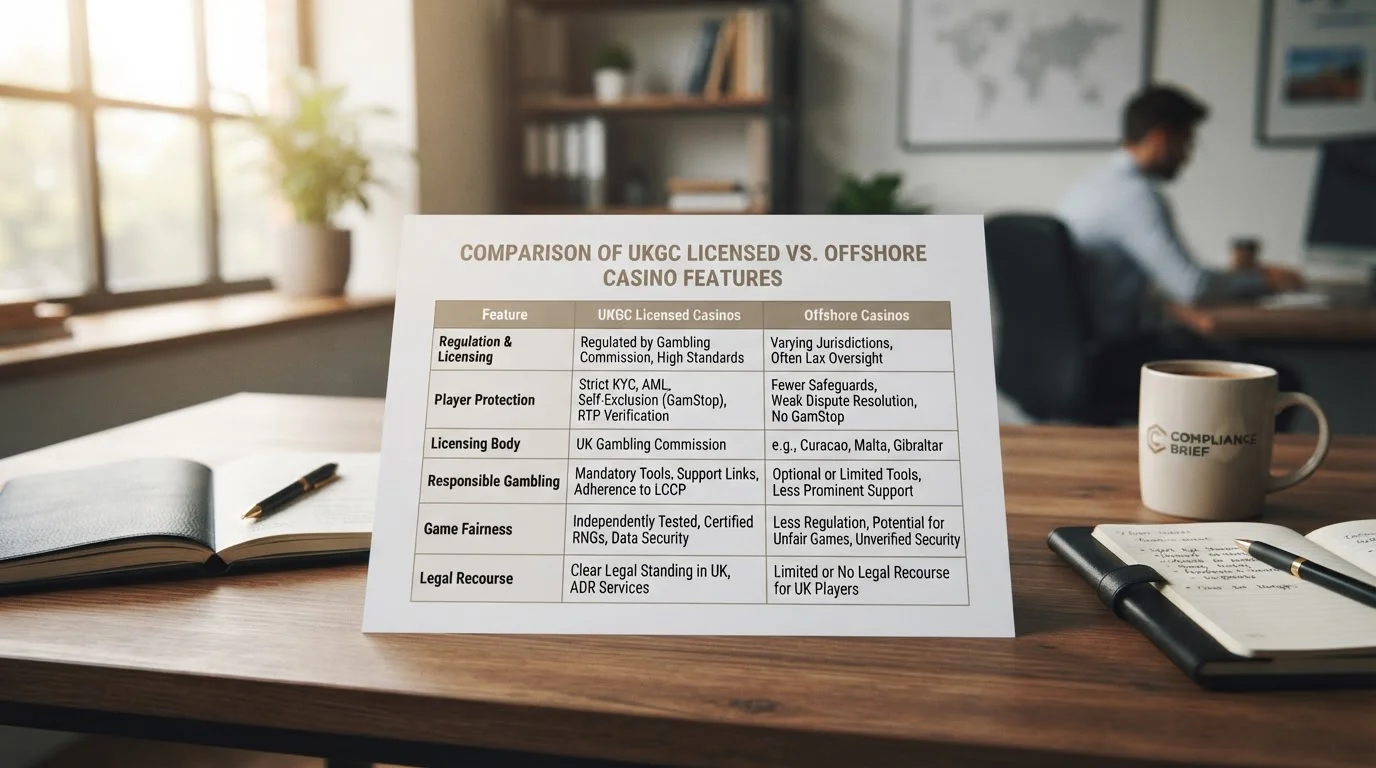
UKGC-licensed casinos enforce strict consumer protections. GamStop self-exclusion is mandatory, allowing players to lock themselves out of all UK-licensed sites for six months, one year, or five years with a single registration. IBAS provides binding alternative dispute resolution, with complaints resolved in approximately eight weeks and outcomes enforceable through UK courts if the operator refuses to comply. Advertising standards prohibit misleading bonus terms, unsubstantiated claims about payout rates, and targeting of minors or vulnerable individuals.
Affordability checks, controversial among some players but mandated by the UKGC, require operators to verify source of funds when deposits or losses exceed certain thresholds. The thresholds vary by operator but typically trigger at £1,000 to £2,000 in net losses over 90 days. Operators must request bank statements, payslips, or tax returns and suspend the account if the player cannot demonstrate that gambling expenditure is within their means. The intent is harm prevention; the effect is friction that high-volume players find intrusive.
Offshore crypto casinos offer none of those protections. GamStop does not extend to offshore operators, which means a player who self-excludes through GamStop can still register and deposit at BC.Game, Roobet, or any other offshore site. Third-party blocking software like Gamban or Betblocker can fill the gap, but they require active installation and maintenance, unlike GamStop which operates automatically at the operator level. Players relying on self-exclusion as a control tool must recognise that offshore casinos represent a circumvention path unless third-party software is in place.
What protections do I lose by using an offshore crypto casino instead of a UKGC-licensed site?
You lose GamStop self-exclusion, IBAS binding dispute resolution, UKGC advertising standards enforcement, and mandatory affordability checks. Offshore operators are not connected to GamStop, so self-exclusion through that system does not block offshore access. Dispute resolution through Curaçao or Anjouan licensing authorities is slow, non-binding, and historically unresponsive compared to IBAS. Affordability checks do not exist offshore, which means no operator will stop you from depositing beyond your means. What you gain is speed, privacy, and no document checks until high withdrawal thresholds, but the regulatory backstops disappear entirely.
IBAS dispute resolution at UKGC-licensed sites is binding: if IBAS rules in your favour, the operator must comply or face licence suspension. Offshore casinos direct disputes to Curaçao licensing authorities or private mediators whose rulings are not binding. The Curaçao Gaming Control Board is notoriously slow to respond, with players reporting six-month waits for responses that often amount to “we reviewed your complaint and side with the operator.” No enforcement mechanism exists to compel an offshore casino to honour a Curaçao ruling if the operator refuses.
Affordability checks vanish offshore. No operator will ask for bank statements or payslips to verify that your gambling spend is sustainable. No threshold triggers intervention. You can deposit and lose unlimited sums without the operator pausing your account to ask whether you can afford it. That removes friction for high-stakes players who find affordability checks intrusive, but it also removes the safety net that might catch a problem gambler before losses spiral.
Advertising standards do not apply offshore. UKGC-licensed casinos cannot make unsubstantiated claims about payout rates, advertise bonuses without prominently displaying wagering requirements, or use language that downplays gambling risk. Offshore casinos face no such constraints. Marketing materials can claim “98% RTP” without publishing the actual figures, advertise bonuses with fine print buried in terms and conditions, and use language that makes gambling sound risk-free. The lack of oversight means offshore advertising should be treated as less reliable than ads from UK-licensed operators.
| Feature | UKGC-Licensed | Offshore No-KYC |
|---|---|---|
| GamStop Self-Exclusion | Mandatory, covers all UK-licensed sites | Not connected, self-exclusion does not apply |
| Dispute Resolution | IBAS, binding, ~8 weeks | Curaçao/Anjouan, slow, non-binding |
| Affordability Checks | Mandatory at thresholds, requires income proof | None, unlimited deposits without checks |
| Advertising Standards | Enforced, misleading claims prohibited | Unregulated, claims not independently verified |
| KYC at Registration | Always required upfront | Not required until withdrawal thresholds (if ever) |
| Cryptocurrency Accepted | No | Yes |
| Withdrawal Speed | 3–5 days for fiat | Minutes to hours for crypto |
| Identity Privacy | Full KYC at signup | Anonymous until thresholds or never |
New Crypto Casinos and Emerging Options
New offshore crypto casinos launch monthly, with many surviving only a few months before disappearing or rebranding under pressure from payment processors, licensing authorities, or lack of player adoption. Established operators like BC.Game, Roobet, and Mystake have multi-year track records and large user bases that provide some confidence in operational stability. New entrants like NineWin and Coins.Game lack that track record, which makes them higher-risk choices for players depositing significant sums.
The offshore market’s lack of barriers to entry means anyone with capital for server hosting and a white-label casino platform can launch a crypto casino. Some new operators are legitimate businesses looking to enter the market. Others are fly-by-night operations that collect deposits for weeks or months before shutting down and disappearing with player funds. The absence of licensing oversight at many new casinos means no regulatory body will investigate if an operator vanishes, and no authority will compel them to return funds.
Newly launched crypto casinos often market aggressive bonuses to attract initial users. A 300% welcome bonus or 500 free spins with no wagering might signal a legitimate operator trying to gain market share, or it might signal an unsustainable promotion designed to collect deposits before the operator folds. Check independent review sites, player forums, and communities like AskGamblers or Trustpilot for early reports on new operators before depositing. A casino that has been live for six months with consistent positive feedback is safer than one that launched last week with zero independent reviews.
No Registration and No KYC Casinos UK 2026 — What to Know
Content created by the «casinopayexp» team