
Casinos That Accept Diners Club UK 2026 — The Full Offshore Picture
 Available in US
Diners Club vanished from UK-licensed casinos on 14 April 2020 when the UK Gambling Commission banned credit card gambling entirely. The ban covers every credit card brand without exception — Visa Credit, Mastercard Credit, American Express, and Diners Club. If you hold a UKGC licence, you cannot process credit card deposits. Full stop.
That leaves offshore casinos operating under Curaçao, Anjouan, or other non-UK licences as the only route for UK players who want to deposit with Diners Club. These sites sit outside GamStop, lack UKGC consumer protections, and process payments through international channels. They are legal for UK adults to access, but they are not regulated by the UKGC.
This guide maps where Diners Club still works for UK players in 2026, which offshore operators accept it, what changes when you leave the UKGC framework, and what the card itself costs you in fees. No fluff, no affiliate cheerleading — just the regulatory facts and the practical trade-offs.
The Current Status of Diners Club at UK Casinos

Zero UKGC-licensed casinos accept Diners Club. The credit card ban that took effect on 14 April 2020 removed every credit card brand from every operator holding a UK Gambling Commission licence. The ban applies to online casinos, sports betting, bingo, poker, and land-based gambling (excluding National Lottery). It is a mandatory licence condition under the UKGC’s Licence Conditions and Codes of Practice, specifically Social Responsibility Code Provision 3.5.5.
The regulatory timeline ran from 14 January 2020, when the UKGC announced the ban, to 14 April 2020, when it took effect. Operators had three months to remove credit card processing from their cashiers. Banks cooperated by implementing merchant category code blocks on gambling transactions from credit cards, reinforcing the ban at the card-issuer level. HSBC, Nationwide, First Direct, M&S Bank, and others rolled out automatic declines for gambling merchants on credit accounts.
The rationale was harm reduction. UKGC research showed 22% of online gamblers using credit cards were problem gamblers, versus 10.5% among non-credit-card users. Gambling with borrowed money correlates with debt accumulation and harm escalation. The ban prevents players from wagering funds they do not have.
Enforcement is straightforward. The ban is a licence condition, not a voluntary code. Violation triggers investigation, fines, licence suspension, or revocation. No operator can opt out. The National Centre for Social Research evaluated the ban in July 2024 and confirmed its effectiveness at reducing credit card gambling among UK players at licensed sites.
Diners Club fell under the ban alongside Visa, Mastercard, and Amex. The legislation does not list specific brands — it bans “credit cards” as a payment category. Whether the card is Diners Club, Visa Credit, or any other brand is irrelevant. If it extends credit, UKGC licensees cannot accept it.
Can I use Diners Club at UK online casinos in 2026?
No. Every casino holding a UKGC licence is prohibited from accepting Diners Club or any credit card. The ban has been in force since 14 April 2020 and remains unchanged as of 2026. UKGC-licensed operators can only accept debit cards, e-wallets, bank transfers, prepaid vouchers, and pay-by-mobile methods.
Why did UK casinos stop accepting Diners Club?
The UKGC banned all credit cards at licensed operators on 14 April 2020 to reduce gambling-related harm. Research linked credit card gambling to higher problem gambling rates and debt accumulation. Diners Club was not singled out — the ban covers every credit card brand including Visa, Mastercard, and American Express. It is a licence condition, meaning every UKGC-licensed operator must comply.
Offshore Casinos That Accept Diners Club from UK Players

Approximately 25-35 offshore casinos claim to accept Diners Club, though availability varies widely in practice. Most operate under Curaçao eGaming licences, with a smaller number holding Anjouan or other offshore permits. None hold UKGC licences. These casinos sit outside GamStop, process payments through international banking channels, and lack the consumer protections mandated for UK-licensed operators.
Diners Club acceptance at offshore casinos is inconsistent. Even when a casino lists Diners Club in its cashier, deposits may fail due to issuer-level gambling blocks, payment processor routing limitations, or 3D Secure authentication problems. The card’s acceptance is strongest among RTG (RealTime Gaming) software casinos and operators targeting Japanese or North American markets where Diners Club has deeper penetration. UK player availability is secondary for most processors.
Before opening an account, verify Diners Club appears in the cashier. Registration does not guarantee payment method availability. Some casinos advertise methods they cannot reliably process.
The casinos below have confirmed Diners Club acceptance across multiple aggregator sources and operate with verifiable Curaçao licensing. Licensing details, ownership entities, and UK player acceptance status are drawn from operator imprints, regulatory databases, and third-party verification.
| Casino | Licence | Min Deposit | Withdrawal Time | Distinguishing Feature |
|---|---|---|---|---|
| 20Bet | Curaçao (Antillephone N.V.) | €20 | 24-72 hours | 5,000+ games, strong sportsbook integration |
| Spinbetter | Curaçao (OGL/2024/228/0604) | €10 | 24-48 hours | Since 2019, 10 cryptocurrencies supported |
| Shazam | Curaçao | $10 | 24-72 hours | RTG software, US player acceptance, Wizard approved |
| Bizzo | Curaçao | €10 | 24-72 hours | Multi-provider library, GBP support |
| Rolletto | Curaçao (OGL/2024/1798/1048) | €10 | 24-48 hours | Santeda network, 84 providers, launched 2020 |
| 22Bet | Curaçao | €10 | 24-72 hours | 8,000+ games, major international brand |
| Slots Ninja | Curaçao | $10 | 48-96 hours | Slots-focused, high bonus percentage (500%) |
20Bet Casino
Launched in 2021 under TechSolutions Group N.V., a Curaçao-registered entity. Holds an Antillephone N.V.-validated Curaçao eGaming licence. No UKGC licence. The primary domain is 20bet.com, with UK players accepted in GBP. The platform hosts 5,000+ games from 80+ providers including Evolution, Pragmatic Play, NetEnt, and Play’n GO. Sportsbook covers 30+ sports alongside the casino.
20Bet lists Diners Club in its international cashier, though actual processing depends on your card issuer and the payment gateway route at the time of deposit. Established presence since 2021 makes it one of the more stable offshore options for UK players seeking Diners Club access, though “stable” remains relative in the offshore space — withdrawal processing runs 24-72 hours, verification can stretch longer, and dispute resolution sits outside UK mechanisms.
The welcome package runs 100% up to €120 plus 120 free spins. Wagering sits at 40x the bonus on slots. Minimum deposit is €20. The bonus terms are clearer than some Curaçao operators, but 40x is standard offshore fare — not generous, not punitive. Players prioritising payment method availability over bonus value will find 20Bet workable. Those chasing promotions can do better elsewhere.
Spinbetter Casino
Operated by Sprut Group B.V. since 2019, making it one of the older Curaçao brands in the current offshore landscape. Licence number OGL/2024/228/0604 (an updated identifier; earlier iterations carried 8048/JAZ under the pre-reform Curaçao system). The platform runs 5,000+ games from top-tier providers — NetEnt, Play’n GO, Evolution Gaming, Pragmatic Play — with a full sportsbook covering 30+ sports.
Spinbetter accepts 10 cryptocurrencies alongside traditional payment methods including Diners Club. Crypto integration is deeper than most offshore competitors, which positions it for players hedging between fiat and digital deposits. UK players can fund accounts in GBP without forced currency conversion at the casino level, though Diners Club transactions may still incur FX fees from your card issuer if routed internationally.
The welcome offer is 100% up to €300 plus 30 free spins, with 35x wagering. Minimum deposit sits at €10. Withdrawal times land in the 24-48 hour range after verification clears, which is faster than the 72-hour offshore average. That said, verification itself can take days depending on document volume and backlog. Canadian and international player focus means UK-specific support is competent but not prioritised.
Shazam Casino
RTG-powered casino operating under a Curaçao licence, with sister sites Lucky Tiger and Rich Palms under the same network. The RTG software focus sets it apart from the NetEnt/Pragmatic Play standard that dominates UK-facing offshore casinos. RTG slots carry a different aesthetic and math model — higher volatility, older interface design, niche appeal. If you grew up on Betsoft and RTG titles, Shazam delivers that library. If you expect modern Megaways and cluster-pays mechanics, look elsewhere.
Shazam accepts US players, which is rare among offshore casinos and signals a different regulatory positioning. Most Curaçao operators avoid the US market due to enforcement risk. The fact Shazam welcomes American accounts suggests its payment processors and banking channels route through jurisdictions comfortable with that exposure. For UK players, this translates to slightly different cashier behaviour and potentially smoother Diners Club acceptance, since US-facing processors maintain better Discover Network integration.
The welcome bonus is 250% up to $2,500 using code ALAKAZAM. Wagering is 35x on bonus plus deposit, meaning a $100 deposit and $250 bonus requires $12,250 in turnover before withdrawal. The percentage looks aggressive until you parse the math. It is a volume play, not a value play. Crypto deposits work across 10 coins, and Diners Club acceptance is confirmed. Wizard of Odds grants it an approval seal, which carries more weight than most affiliate badges — Wizard verification involves actual deposit and withdrawal testing, not promotional partnerships.
Rating sits at 3.9 out of 5 across 137 reviews on WizardOfOdds, placing it in the mid-tier for offshore reliability. Complaints cluster around withdrawal delays and bonus term opacity, which is standard offshore territory. The RTG library is the real differentiator here, not the bonus or the speed.
Bizzo Casino
Mid-tier Curaçao-licensed operator running a multi-provider game library. No marquee features, no standout weaknesses. Bizzo operates in the broad middle of the offshore market — not the premium end occupied by established crypto casinos with deep liquidity, not the bottom tier of unreliable newcomers with opaque ownership. It accepts UK players in GBP, lists Diners Club among payment methods, and processes withdrawals in the 24-72 hour standard range.
Game selection spans slots, live dealer tables, and standard table games from recognisable providers. The platform does not innovate, which is not necessarily a flaw. Offshore casinos that try to reinvent the experience often introduce friction. Bizzo delivers baseline functionality — register, deposit, play, withdraw — without bells that break. For players whose priority is “does my Diners Club work here,” that is enough.
Public specifics on Bizzo are thinner than for 20Bet or Spinbetter, which reflects its positioning. It is not chasing brand recognition or premium market share. It is a working offshore option among many. Verify Diners Club in the cashier before committing. Aggregator listings say yes; your specific card issuer and the processor route at deposit time determine whether it actually clears.
Rolletto Casino
Santeda International B.V. launched Rolletto in 2020, positioning it directly into the UK market shift that followed the April credit card ban and the broader tightening of UKGC restrictions. Curaçao licence OGL/2024/1798/1048. The platform runs on Upgaming software and hosts 4,000+ games from 84 providers. Sportsbook integration covers 30+ sports. Crypto-friendly setup supports 10 digital currencies alongside 35+ traditional payment methods, Diners Club included.
Santeda operates multiple casino brands under similar licensing structures, creating a network effect. If you encounter Santeda elsewhere in the offshore ecosystem, expect parallel operations — same payment processors, similar withdrawal workflows, shared customer support infrastructure. This is not necessarily negative; network operators achieve economies of scale that lone-wolf casinos cannot match. Withdrawal processing, verification backlogs, and dispute handling benefit from centralised systems. The downside is reduced differentiation. Rolletto, like its Santeda siblings, is a competent offshore platform without a unique selling point beyond “we accept what UKGC sites now ban.”
Launched in 2020 means Rolletto has three years of operational history, which clears the “fly-by-night startup” concern but does not confer the decade-plus credibility of a Bitstarz or similar. UK player acceptance in GBP confirmed. Diners Club listed. Minimum deposit €10. Verification required before first withdrawal, standard KYC documentation. Withdrawal times land in 24-48 hours after clearance, faster than the offshore average.
22Bet Casino
One of the larger offshore operators by sheer game count — 8,000+ titles claimed, though that figure aggregates variants and includes sportsbook markets alongside casino games. Strip away the sports betting and you are still looking at a library in the thousands. Curaçao-licensed, no UKGC permit. Major international presence with GBP support for UK players.
22Bet appears on every major aggregator listing offshore casinos, which signals either deep affiliate penetration or genuine market reach. Probably both. High bonus offers are a signature — 100% up to €1,000 and above, depending on the promotional cycle. Those bonuses carry steep wagering, often 40x or higher, which turns the headline figure into a grind. Read the terms before chasing four-figure match percentages.
Diners Club acceptance is listed across multiple sources. Actual processing reliability at 22Bet is harder to verify than at smaller, more transparent operators. Large offshore casinos route payments through multiple processors depending on geography, currency, and card network. Your Diners Club deposit might succeed on Tuesday and fail on Thursday because the processor switched. This is not unique to 22Bet — it is endemic to offshore payment routing — but scale amplifies the variability.
Withdrawal processing sits in the 24-72 hour range after verification. Customer support handles volume but not nuance. If your issue is “deposit did not credit” or “withdrawal pending,” they can track it. If your issue is “bonus terms conflict with the promotional email,” expect generic responses. For players who prioritise library size and brand recognition over personalised service, 22Bet delivers. For those who value responsive support and transparent operations, smaller operators often perform better.
Slots Ninja Casino
Slots-focused Curaçao-licensed casino. The name signals the niche. Table games and live dealer options exist but are not the draw. The welcome bonus is 500% up to $5,000, which reads like a headline designed to stop scrollers mid-swipe. Parse the fine print: 50x wagering on bonus plus deposit. A $100 deposit triggers a $500 bonus, requiring $30,000 in turnover before you can withdraw. That is not a bonus; it is a lock-in mechanism dressed as generosity.
High-percentage bonuses at offshore casinos function as retention tools, not value adds. The 500% figure ensures you play through the bonus rather than deposit, win, and leave. If your plan is to take the bonus, meet the wagering, and cash out, you are playing the casino’s game on the casino’s terms. If your plan is to deposit, play your own stakes, and ignore the bonus, the 500% is irrelevant noise.
Slots Ninja holds a 3.8 out of 5 rating across 68 reviews on WizardOfOdds. That is mid-range offshore reliability — functional, not exceptional. Complaints centre on withdrawal delays and aggressive bonus terms, which aligns with the 50x wagering structure. Diners Club acceptance is confirmed on aggregator listings. Curaçao licence verified. Minimum deposit $10. Withdrawal processing runs 48-96 hours, slower than competitors.
The appeal here is narrow. If you want slot variety and your card is Diners Club, Slots Ninja works. If you want fast withdrawals, transparent terms, or anything beyond spinning reels, better options exist in the offshore space.
Which offshore casinos accept Diners Club from UK players?
The seven casinos above — 20Bet, Spinbetter, Shazam, Bizzo, Rolletto, 22Bet, and Slots Ninja — accept Diners Club deposits from UK players as of 2026. All operate under Curaçao licences and sit outside the UKGC regulatory framework. Additional offshore casinos claim Diners Club acceptance (Springbok, Slotastic, Uptown Aces, and others), but verification and UK player access vary. The RTG casino network shows higher Diners Club acceptance rates than NetEnt/Pragmatic Play platforms, likely due to US-market payment processor integration.
UK-Licensed vs Offshore Casinos: What Changes for UK Players
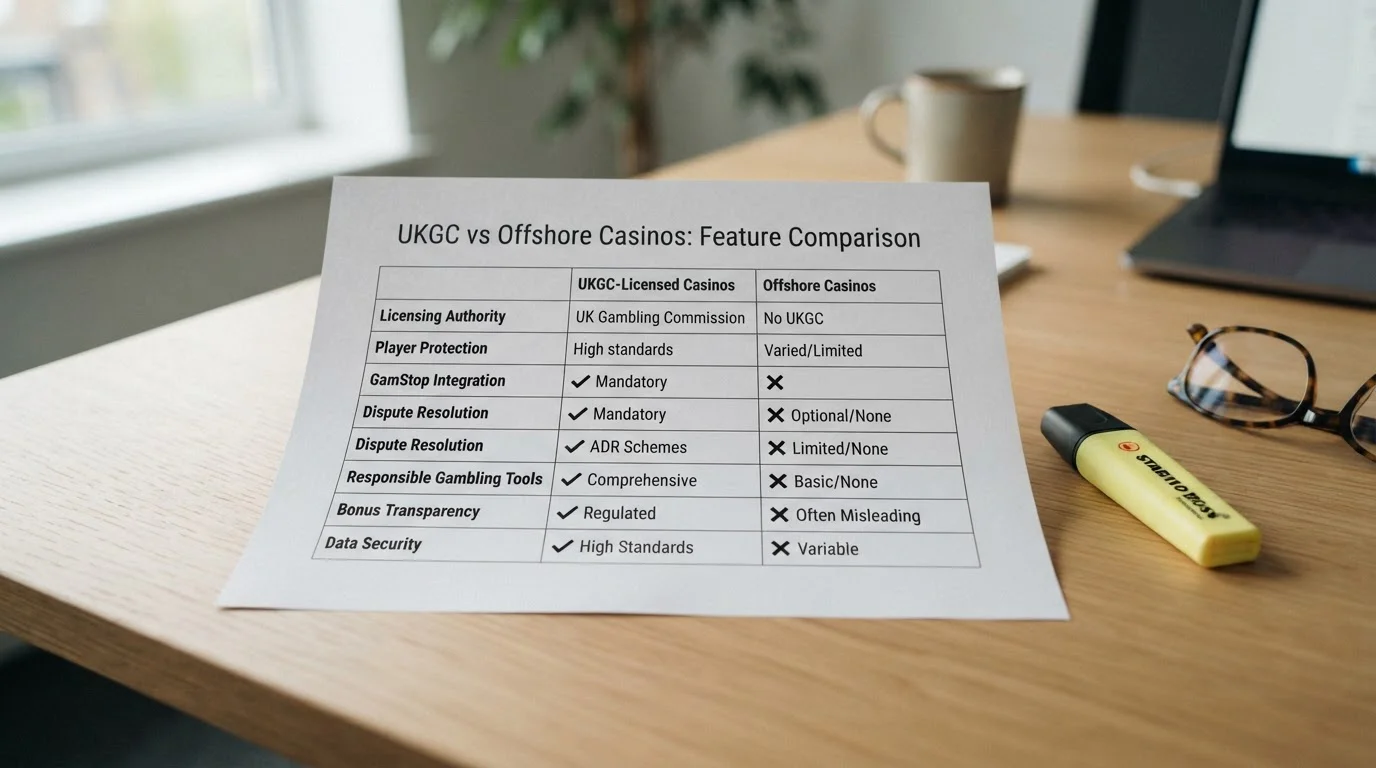
Moving from a UKGC-licensed casino to an offshore operator trades regulatory protections for payment method flexibility. The trade is not hypothetical. When you deposit at Rolletto instead of Betway, you lose GamStop integration, UKGC dispute resolution, segregated fund requirements, and mandatory affordability checks. You gain access to Diners Club deposits, higher stake limits, uncapped bonuses, and faster account opening. Whether that trade makes sense depends on why you are gambling and what you value.
The table below structures the differences. UKGC-licensed operators appear in the left column, offshore sites in the right. These are not opinions or projections — they are regulatory facts as of 2026.
| Feature | UKGC-Licensed Sites | Offshore Sites |
|---|---|---|
| GamStop Integration | Mandatory. Self-exclusion blocks all UKGC licensees. | Not integrated. GamStop does not apply. |
| Dispute Resolution | IBAS or UKGC-approved ADR, free to players. | Curaçao eGaming or none. Resolution often requires legal escalation. |
| Withdrawal Speed | Often instant to 24 hours (e-wallets). | 24-96 hours after verification. Pending periods standard. |
| Stake Limits | £5 per spin on slots (since Sept 2024). | No stake caps. Players can wager hundreds per spin. |
| Bonus Wagering Caps | Maximum 10x for reload bonuses (UKGC policy). | No caps. 40x-60x common, 100x possible. |
| Payment Methods | Debit cards, e-wallets, bank transfer. No credit cards. | Credit cards (Diners Club, others), crypto, debit, e-wallets. |
| Verification Speed | Fast (often automated via Onfido, Jumio). | Slower. Manual document review, 24-72 hours common. |
| Segregated Funds | Mandatory. Player funds held separately from operating capital. | Not required. Funds may be commingled. |
| Credit Card Acceptance | Banned since April 2020. | Available at offshore operators. |
The GamStop line is the most consequential for vulnerable players. If you have self-excluded through GamStop, UKGC-licensed casinos block you automatically. Offshore casinos do not. The regulatory split creates a bypass route around self-exclusion, which is a feature for some players and a risk vector for others. If you excluded yourself because you cannot control your gambling, offshore access defeats the purpose of exclusion. If you excluded yourself for other reasons and want back in, offshore casinos offer that door.
Dispute resolution at UKGC sites routes through IBAS (Independent Betting Adjudication Service) or similar ADR schemes at no cost to the player. Offshore casinos route through Curaçao eGaming’s complaint portal, which is less structured, slower, and carries no enforcement mechanism if the operator ignores the finding. Players who hit a payment dispute or a confiscated balance at an offshore casino often discover their recourse is “complain to the regulator and hope,” not “escalate to a neutral arbiter with teeth.”
Withdrawal speeds at UKGC-licensed operators improved dramatically between 2020 and 2024. E-wallet withdrawals at many UKGC sites now clear instantly or within hours. Offshore casinos still operate on the older 24-72 hour pending model, with verification adding days on the first withdrawal. The speed gap reflects regulatory pressure on UKGC operators and the absence of that pressure offshore.
Stake limits — £5 per spin on slots at UKGC sites since September 2024 — do not exist offshore. Players accustomed to £10, £20, or £50 spins cannot place those bets at UK-licensed casinos anymore. Offshore operators do not cap stakes. That freedom is valuable for high rollers and dangerous for impulsive players. The same lack of caps applies to bonuses: offshore casinos routinely attach 40x, 50x, or 60x wagering to promotions, where UKGC sites are capped at 10x for most reload offers.
Segregated funds — the requirement that UKGC operators hold player balances separately from operating capital — ensures your balance survives if the casino goes insolvent. Offshore operators are not required to segregate. If an offshore casino folds, your balance may be an unsecured liability in a Curaçao bankruptcy proceeding. The risk is not theoretical. Offshore casinos fail, pause withdrawals, and ghost players more often than UKGC-licensed operators.
Is it legal for UK players to use offshore casinos that accept Diners Club?
Yes. It is legal for UK adults to gamble at offshore casinos not licensed by the UKGC. The law prohibits unlicensed operators from advertising to UK consumers, but it does not prohibit UK residents from accessing and using offshore gambling sites. Players who use Curaçao or Anjouan-licensed casinos are not breaking UK law. However, these sites operate outside UKGC consumer protections, do not integrate with GamStop, and lack UKGC-mandated dispute resolution mechanisms.
How to Deposit with Diners Club at Offshore Casinos
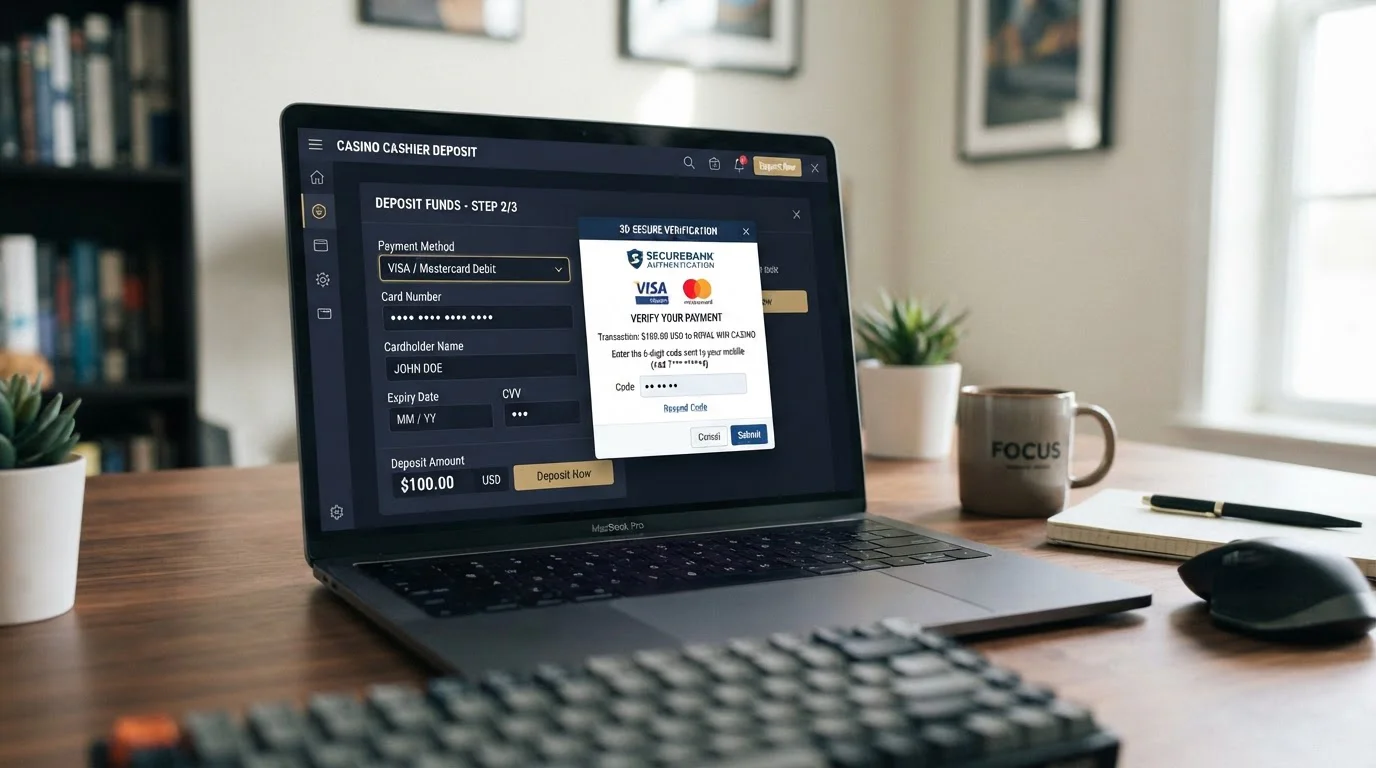
The deposit process at offshore casinos follows the standard credit card flow, with additional friction from 3D Secure authentication and issuer-level gambling blocks. Diners Club deposits succeed or fail in seconds. There is no pending state. If the payment clears, funds hit your casino balance instantly. If it declines, you see an error at checkout.
Step one: register an account. Offshore casinos require an email, password, and basic personal details (name, address, date of birth, phone number). Some operators ask for currency preference at registration. Choose GBP if you want to avoid forced currency conversion at the casino level. Your Diners Club issuer may still convert GBP to your account currency (USD, EUR, etc.) and apply FX fees, but at least the casino is not adding a second conversion layer.
Step two: navigate to the cashier. Most offshore casinos place the deposit button in the top-right corner or under an account menu. Click deposit, and the cashier loads. Payment methods appear as icons or a dropdown list. If Diners Club is available, it appears alongside Visa, Mastercard, and other cards. If you do not see it, the casino either does not support it or your region/account status blocks access.
Step three: select Diners Club and enter card details. You will need the 14-digit card number (Diners Club uses a shorter format than Visa/Mastercard’s 16 digits), expiry date, and CVV. Some cashiers also ask for the cardholder name and billing address. Enter details exactly as they appear on your card and billing statement. Mismatches between the name on your card and the name on your casino account can trigger declines.
Step four: choose deposit amount. Minimum deposits typically range from $10 to €20. Diners Club transactions at casinos often cap at $500 per deposit, though limits vary by operator and processor. If you need to deposit more, split it across multiple transactions or use a different method.
Step five: 3D Secure authentication. Modern card payments require 3D Secure verification — a pop-up or redirect to your card issuer’s portal where you confirm the transaction via password, SMS code, biometric scan, or similar. Complete the authentication within the time limit (usually 60-90 seconds). If you cancel or let it time out, the deposit fails.
Step six: confirmation or decline. If the payment succeeds, the cashier shows a confirmation screen and credits your casino balance instantly. If it fails, an error message appears. Common decline reasons: issuer-level gambling merchant block, insufficient credit limit, 3D Secure timeout, incorrect card details, processor routing failure, or suspected fraud flag.
Troubleshooting failures: if your Diners Club deposit declines, try these steps. First, verify your card details are correct and your account has available credit. Second, check with your card issuer whether they block gambling transactions. Many Diners Club issuers — particularly in the US and UK — automatically decline gambling merchants to prevent problem gambling and compliance risks. If your issuer blocks gambling, Diners Club will not work at any casino regardless of licensing. Third, try a different offshore casino. Payment processors vary by operator. A decline at 20Bet does not mean Diners Club will fail at Spinbetter. Fourth, attempt the deposit at a different time. Processor routing changes hourly based on network load and fraud thresholds. A transaction that fails at noon may succeed at 8pm.
If Diners Club consistently fails across multiple offshore casinos, your issuer likely blocks gambling merchants. At that point, your options are to request your issuer remove the block (unlikely to succeed) or switch to a different payment method.
How long do Diners Club casino deposits take to process?
Diners Club deposits at offshore casinos process instantly if approved. Funds appear in your casino balance within seconds of completing 3D Secure authentication. If the transaction declines, you see the error immediately at checkout. There is no pending period for credit card deposits.
Do I need to verify my Diners Club card at offshore casinos?
Most offshore casinos require identity verification before your first withdrawal, which includes proof of payment method. You will need to upload a photo or scan of your Diners Club card showing the first six and last four digits, your name, and the expiry date (CVV must be hidden). Verification typically takes 24-72 hours. Some casinos allow deposits without verification but lock withdrawals until documents are approved.
Fees, Limits and Processing Times for Diners Club
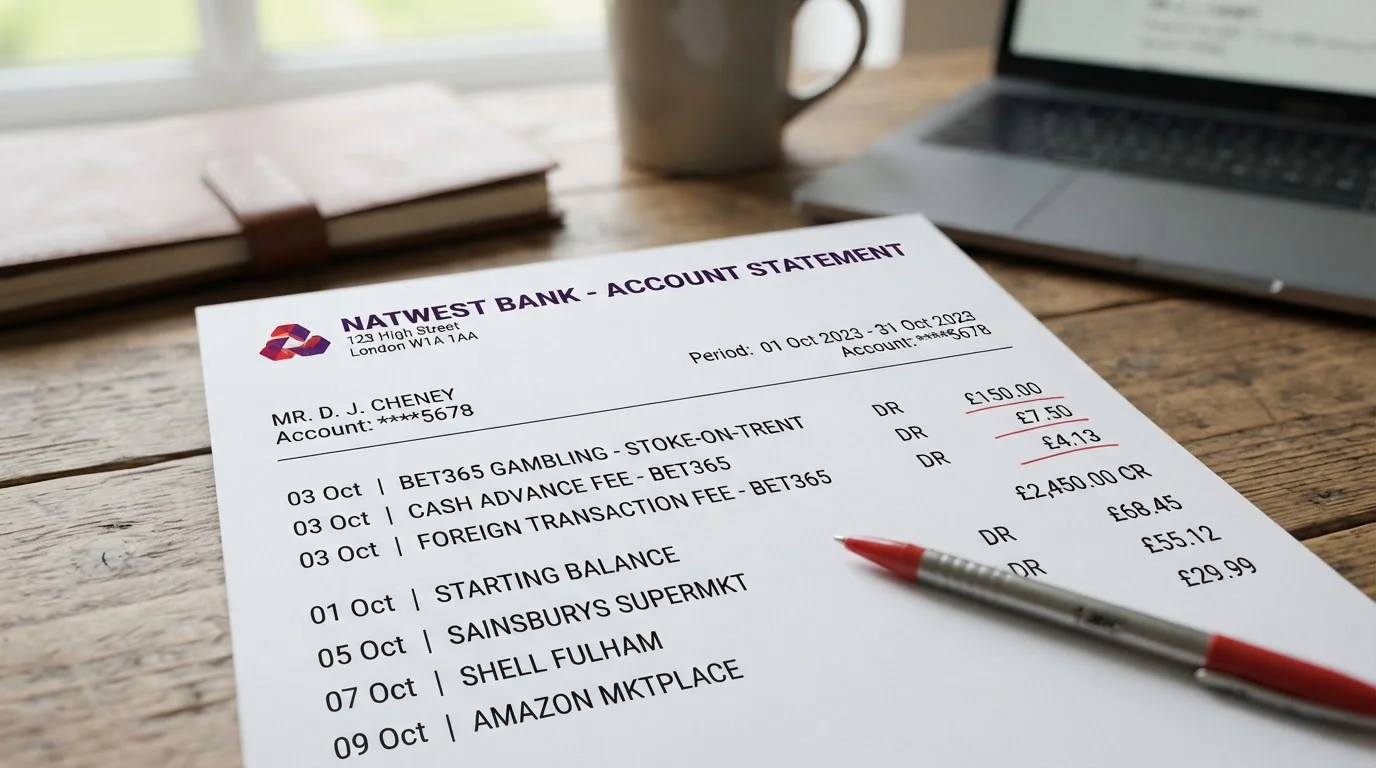
Diners Club casino deposits often incur fees you would not pay with debit cards or e-wallets. These fees come from your card issuer, not the casino. The costs stack: cash advance fees, foreign transaction fees, and immediate interest charges can turn a £100 deposit into £105-£108 in actual cost depending on your issuer’s terms.
Cash advance treatment is the big one. Many Diners Club issuers categorise gambling transactions as cash advances rather than standard purchases. This triggers three consequences: an upfront cash advance fee (commonly 5% of the transaction or a minimum of $10, whichever is higher), immediate interest accrual from the day of the transaction (no grace period like regular purchases receive), and a higher APR than your standard purchase rate (cash advance APRs often run 25-30%).
Example: you deposit £100 at an offshore casino using Diners Club. Your issuer treats it as a cash advance. You pay a £5 fee (5% of £100), the transaction posts to your account at a 28% APR starting immediately, and if you carry the balance for one month, you owe an additional £2.33 in interest. Your £100 deposit cost you £107.33, a 7.3% fee. That is steeper than most e-wallet charges.
Not all Diners Club issuers treat gambling as a cash advance. Terms vary by issuer, account type, and jurisdiction. US-issued Diners Club cards are more likely to apply cash advance treatment than European cards, but this is not universal. Check your cardholder agreement or call your issuer to confirm how they categorise gambling transactions. If they call it a cash advance, factor that cost into your decision.
Foreign transaction fees apply when your card issuer and the casino’s payment processor operate in different currencies. Even if you deposit in GBP at the casino, the processor may route the transaction through EUR or USD, triggering an FX fee. Typical foreign transaction fees run 2.5-3% of the transaction value. A £100 deposit costs you an additional £2.50-£3.00 if an FX fee applies.
Currency conversion happens in layers. First, the casino may convert your deposit to its base currency if you choose a currency other than GBP at registration. Second, the payment processor may convert currencies between the casino and the card network. Third, your card issuer converts the final amount to your account currency if you hold a non-GBP Diners Club card. Each conversion layer shaves 1-3% off your value. To minimise this, register your casino account in GBP if you are depositing from the UK, and hold a GBP Diners Club card if possible.
Deposit limits vary by casino and processor. The most common range is $10-$500 per transaction. Some offshore casinos accept higher Diners Club deposits ($1,000+) for VIP or crypto-friendly accounts, but $500 is a practical ceiling for most players. If you need to deposit more, you will need to make multiple transactions (each potentially incurring separate fees) or switch to a method with higher limits like cryptocurrency or bank transfer.
Processing speed: instant on the deposit side. Diners Club transactions either approve and credit your casino balance in seconds, or they decline immediately. There is no multi-day pending period like bank transfers.
Withdrawal limits are irrelevant because Diners Club withdrawals are rare to nonexistent at online casinos. This is covered in the next section.
Are there fees for depositing with Diners Club at online casinos?
Yes, though the fees come from your card issuer rather than the casino. Many Diners Club issuers treat gambling transactions as cash advances, triggering a fee of 5% or $10 minimum plus immediate interest accrual at a higher APR than standard purchases. Foreign transaction fees of 2.5-3% apply if the payment routes through a different currency. These costs stack, potentially adding 7-10% to your deposit. Check your cardholder agreement to confirm how your issuer categorises gambling transactions.
What are the deposit limits when using Diners Club at casinos?
Typical Diners Club deposit limits at offshore casinos range from $10 to $500 per transaction. Some operators accept higher amounts for VIP accounts, but $500 is a common ceiling. If you need to deposit more, you will either make multiple transactions (each potentially incurring separate fees) or use a different payment method like cryptocurrency or bank transfer.
Diners Club Withdrawals: Availability and Alternatives
Diners Club withdrawals are rare at online casinos. Most offshore operators do not support payouts to Diners Club cards, even when they accept Diners Club deposits. This asymmetry exists because card withdrawals face stricter anti-money-laundering scrutiny and higher chargeback risk than deposits. Processors that handle Diners Club deposits often refuse to route Diners Club withdrawals.
When an offshore casino lists “Diners Club” under payment methods, read it as “deposits only” unless the site explicitly states withdrawals are supported. Even Visa and Mastercard — far more widely supported than Diners Club — see withdrawal restrictions at many offshore casinos. Diners Club fares worse due to its smaller network presence and the Discover Global Network’s lighter international coverage compared to Visa/Mastercard.
Practical consequence: if you deposit with Diners Club, plan to withdraw via a different method. The most common withdrawal options at offshore casinos are e-wallets (Skrill, Neteller, ecoPayz), bank transfer, and cryptocurrency. E-wallets are faster — often 24-48 hours after verification clears. Bank transfers take 3-7 business days. Cryptocurrency withdrawals process in minutes to hours depending on blockchain congestion, though you need a crypto wallet and familiarity with digital currency handling.
Some offshore casinos require you to verify the same payment method for withdrawals that you used for deposits. If you deposited with Diners Club, this creates a problem: you cannot withdraw to Diners Club (not supported), but the casino wants proof you own the Diners Club card before approving a withdrawal to your e-wallet or bank account. Solution: upload Diners Club verification documents (card photo showing first six and last four digits, cardholder name, expiry date) alongside your chosen withdrawal method documents (e-wallet screenshot, bank statement). This satisfies the “verify your deposit method” requirement while routing the withdrawal through a method the casino actually supports.
If an offshore casino claims to support Diners Club withdrawals, test it with a small payout before depositing large sums. “Supported” in the cashier does not always mean “functional in practice.” Payment processors change, withdrawal routes fail, and documentation requirements vary by account. Better to discover a withdrawal method does not work on a £50 test than a £5,000 balance.
Timeframe expectations for non-Diners-Club withdrawals: e-wallet payouts at offshore casinos typically process in 24-72 hours after verification clears. First withdrawals take longer because verification itself runs 24-72 hours depending on document backlog. Subsequent withdrawals are faster once you are verified. Bank transfers run 3-7 business days. Cryptocurrency withdrawals process in hours but require a crypto wallet and expose you to price volatility between casino payout and fiat conversion.
Can I withdraw winnings to my Diners Club card?
Rarely. Most offshore casinos do not support Diners Club withdrawals, even when they accept Diners Club deposits. You will need an alternative withdrawal method such as an e-wallet (Skrill, Neteller), bank transfer, or cryptocurrency. Some casinos require you to verify your Diners Club card before approving withdrawals to a different method, so upload card verification documents alongside your chosen payout method.
Alternatives to Diners Club at UK Casinos
If Diners Club does not work — either because you are playing at a UKGC-licensed casino where credit cards are banned, or because your card issuer blocks gambling transactions — the UK market offers multiple alternatives. UKGC-licensed casinos accept debit cards, e-wallets, bank transfers, prepaid vouchers, and pay-by-mobile methods. Offshore casinos accept all of those plus cryptocurrency.
The table below maps payment methods available at UKGC-licensed operators. These methods are legal, widely supported, and faster than Diners Club in most cases.
| Method | Speed | Min Deposit | Fees | Availability |
|---|---|---|---|---|
| Visa Debit | Instant | £5-£10 | None from casino; issuer may charge | Universal at UKGC sites |
| Mastercard Debit | Instant | £5-£10 | None from casino; issuer may charge | Universal at UKGC sites |
| PayPal | Instant | £10 | None from casino | Wide (restricted at some UKGC sites since 2024) |
| Skrill | Instant | £10 | None from casino; 1-2% deposit fee possible | Wide |
| Neteller | Instant | £10 | None from casino; 1-2% deposit fee possible | Wide |
| Bank Transfer | 1-3 business days | £10-£20 | None from casino | Universal |
| Pay by Mobile | Instant | £10-£30 | None from casino; appears on phone bill | Growing (Boku, Payforit) |
| Paysafecard | Instant | £10 | None from casino | Wide (prepaid voucher) |
Visa Debit and Mastercard Debit are the closest Diners Club equivalents in terms of user experience. You enter card details, transaction clears in seconds, funds appear instantly. The key difference: debit cards draw from your bank balance rather than extending credit, which keeps them legal at UKGC-licensed sites. No cash advance fees, no interest charges, no credit limit concerns. Downside: if your bank balance is low, you cannot deposit. That is a feature from a harm-reduction perspective, but it removes the “borrow to gamble” flexibility credit cards provide.
E-wallets — PayPal, Skrill, Neteller — add a layer between your bank and the casino. You fund the e-wallet via bank transfer or debit card, then deposit from the e-wallet to the casino. This creates separation in your bank statement (your bank sees an e-wallet payment, not a casino payment) and speeds up withdrawals. Many UKGC casinos process e-wallet payouts instantly or within hours, whereas debit card withdrawals can take days. Trade-off: some UKGC casinos exclude e-wallet deposits from bonus eligibility. Check bonus terms before funding via Skrill or Neteller.
PayPal availability at UK casinos declined in 2024. Several major UKGC operators removed PayPal from their cashiers citing operational and compliance reasons. PayPal itself tightened its gambling merchant policies. If PayPal is a priority, verify it appears in the cashier before registering. Skrill and Neteller remain widely supported.
Bank transfers (Open Banking, Trustly, Instant Bank Transfer) work well for players comfortable with direct bank access. You authorise the casino to pull funds from your bank account via a secure portal. No card details, no e-wallet middleman. Processing is near-instant for deposits and 1-3 business days for withdrawals. Minimum deposits run higher (£10-£20) than card methods. Bank transfers suit players depositing larger amounts who do not want card fees.
Pay by Mobile (Boku, Payforit) routes your deposit through your mobile phone bill or pay-as-you-go balance. You enter your mobile number at the cashier, confirm via SMS, and the charge appears on your next phone bill. Deposits are instant. Limits are low (£10-£30 per transaction, often capped at £240-£300 per month). Withdrawals are not supported — payouts must route through a different method. Pay by Mobile works for casual players making small deposits who do not want to share bank or card details.
Paysafecard is a prepaid voucher you buy with cash at retail locations. You enter the 16-digit PIN at the casino cashier, funds transfer instantly. No bank account, no card, no identity trail beyond the purchase. Paysafecard suits players prioritising privacy or those without bank access. Downside: you cannot withdraw to Paysafecard. Winnings must cash out via bank transfer or another method. Voucher fees add up if you make frequent deposits.
Cryptocurrency is available at offshore casinos but not UKGC-licensed sites. Bitcoin, Ethereum, Litecoin, and other coins bypass traditional banking entirely. Deposits and withdrawals process in minutes to hours depending on blockchain congestion. No card fees, no issuer blocks, no currency conversion if the casino operates in crypto. Trade-offs: price volatility (your balance fluctuates with coin value), wallet management complexity, and irreversibility (send crypto to the wrong address and it is gone). Crypto works for players comfortable with digital currency who prioritise speed and privacy over stability.
What are the alternatives to Diners Club at UK-licensed casinos?
UKGC-licensed casinos accept Visa Debit, Mastercard Debit, PayPal (where available), Skrill, Neteller, bank transfer, pay-by-mobile (Boku, Payforit), and Paysafecard. All credit cards including Diners Club are banned at UK-licensed operators since April 2020. Debit cards and e-wallets offer instant deposits with lower fees than credit cards and no cash advance charges.
Bonuses When Depositing with Diners Club
Offshore casinos accepting Diners Club offer the same bonus structures they provide for other payment methods. Welcome bonuses at Curaçao-licensed operators typically run 100-250% match on first deposit, with free spins attached. Wagering requirements range from 35x to 60x the bonus, occasionally higher. These terms are steeper than the 10x wagering cap mandated at UKGC-licensed casinos but standard for offshore operators.
Payment method exclusions are less common for Diners Club than for e-wallets. Skrill and Neteller deposits often disqualify players from bonuses due to abuse history (players depositing via e-wallets, claiming bonuses, and withdrawing without play). Credit cards face fewer restrictions because chargebacks and verification requirements reduce bonus abuse. If you deposit with Diners Club, most offshore casinos will credit the welcome offer automatically or after entering a bonus code.
Wagering contributions vary by game type. Slots usually contribute 100% toward wagering requirements, meaning every £1 wagered counts as £1 toward clearing the bonus. Table games contribute 10-20%, and live dealer games often contribute 0% or are excluded entirely. A 100% bonus with 40x wagering requires £4,000 in turnover on a £100 deposit. If you play blackjack at 10% contribution, that same bonus requires £40,000 in turnover. Read the terms before accepting.
Sticky vs withdrawable bonuses: most offshore casino bonuses are sticky (non-withdrawable). The bonus amount itself cannot be cashed out; only winnings above the bonus are withdrawable after wagering is met. Example: you deposit £100, receive a £100 bonus, wager through 40x, and finish with £250 in your balance. You can withdraw £150 (your £250 balance minus the £100 sticky bonus). Some casinos use withdrawable bonuses where the bonus itself becomes cashable after wagering, but this is rarer and usually carries higher wagering requirements.
Bonus hunting with Diners Club is inadvisable. The card’s cash advance fees (5% + interest) and foreign transaction fees (2.5-3%) add 7-10% to your deposit cost. Even a generous 100% bonus does not offset that expense once you account for wagering requirements. Better to deposit with Diners Club for convenience or necessity, not for bonus value. If maximising bonus value is the goal, use a debit card or e-wallet with no fees.
Mobile Casino Access with Diners Club
Diners Club works the same on mobile as on desktop. Offshore casinos offering Diners Club deposits process the payment through the same gateways regardless of device. You open the mobile casino site or app, navigate to the cashier, select Diners Club, enter your card details, and complete 3D Secure authentication. The transaction clears in seconds if approved.
Mobile casino interfaces are often cleaner than desktop versions. Payment method icons are larger, form fields auto-scale to screen size, and 3D Secure authentication integrates with mobile browser autofill and biometric verification (Face ID, fingerprint scan). If anything, depositing on mobile is smoother than desktop because modern mobile browsers handle payment flows better than older desktop setups.
One caveat: 3D Secure pop-ups on mobile can timeout faster if your phone switches between Wi-Fi and mobile data mid-transaction, or if you background the browser app during authentication. Complete the 3D Secure step without interruption. If your phone sleeps or you switch apps, the payment may fail and you will need to retry.
App vs mobile browser: most offshore casinos offer both a mobile-optimised website and a dedicated app (iOS and Android). The app versions are often smoother, with faster load times and persistent login. However, Diners Club processing works identically in both environments. If you prefer browser-based play for security or convenience, you lose nothing in terms of payment functionality.
Safety and Responsible Gambling
Offshore casinos operate outside UKGC protections, which shifts responsibility for safe gambling onto the player. GamStop does not apply. No mandatory affordability checks exist. Stake limits are not enforced. Bonus wagering can run to 60x or higher. Verification can delay or block withdrawals. Dispute resolution routes through Curaçao eGaming’s complaint portal, which lacks the structure and enforcement of UKGC’s ADR mechanisms.
Before registering at an offshore casino, verify its licence. Curaçao eGaming licences are verifiable via the operator’s website footer (look for licence numbers like OGL/2024/228/0604) or by contacting Curaçao eGaming directly. Anjouan licences are harder to verify due to less transparent registry systems. If a casino does not display licence details or the licence number does not resolve when checked, do not deposit.
Self-exclusion tools at offshore casinos are site-specific. If you self-exclude at 20Bet, that block does not apply to Spinbetter or Rolletto. You must request exclusion separately at each casino. Some offshore operators honour multi-site exclusions within their network (e.g. Santeda International brands may share self-exclusion data), but this is not universal. Do not assume exclusion at one offshore casino protects you elsewhere.
If you have used GamStop, offshore casinos are a bypass route. That is either a practical necessity (you excluded yourself for reasons unrelated to gambling harm and want to play again) or a critical risk (you excluded yourself because you cannot control your gambling, and offshore access removes the barrier you erected). Be honest about which camp you fall into.
Deposit limits and loss limits at offshore casinos are optional and player-set. The casino will not stop you from depositing more unless you have manually configured a cap in your account settings. UKGC-licensed operators are required to intervene when players show signs of harm (sudden large deposits, chasing losses, extended session times). Offshore operators are not. Your behaviour is your responsibility.
If gambling is causing you harm — financial, emotional, relational — stop. The GamStop register is free and covers all UKGC-licensed operators (gamstop.co.uk). Register for a minimum of six months. If you find yourself seeking offshore casinos specifically to bypass GamStop, that is a red flag. Contact the National Gambling Helpline (0808 8020 133, free and confidential) or visit BeGambleAware.org for support resources.
Diners Club’s absence from UKGC casinos is not an accident. The credit card ban exists to prevent gambling with borrowed money, which the UKGC identified as a harm escalation factor. Using Diners Club at offshore casinos reintroduces that risk. If you deposit with Diners Club because it is your only payment option, that is situational. If you deposit with Diners Club because you have exhausted your debit balance and want to keep playing on credit, stop.
Casino Deposit Methods UK 2026 — Compare Payment Options
Content created by the «casinopayexp» team