
Casino Sites That Accept Skrill UK 2026: Verified Brands, Real Fees & the Bonus Trade-Off
 Available in US
Skrill still processes at UK-licensed casino sites in 2026. The wallet is live, the fees are published, and the instant-deposit claim holds. What the affiliate lists bury in the small print is the price: most operators disqualify Skrill deposits from the welcome offer, and once your winnings land back in the wallet, the cost of moving them to your bank account starts at 1.75% plus a EUR 3.50 floor. Speed traded for bonus, and nobody runs the numbers.
This one does. Fourteen UKGC-licensed brands that take Skrill for deposits and pay withdrawals back into the wallet, with the minimum at each, the realistic payout time, and whether the site’s bonus terms let Skrill deposits qualify. The mechanics step by step, the two-layer fee structure spelled out, and a straight answer on what “Skrill casinos not on GAMSTOP” pages are actually selling — because Skrill’s own contract forbids payments to unlicensed gambling services, and three Financial Ombudsman decisions from the last eighteen months show account freezes over gambling transactions are real and routine.

Is Skrill Still Working at UK Casinos in 2026?
Yes. Skrill Limited (FCA firm reference 900001) remains authorised under the Electronic Money Regulations, Paysafe’s newsroom across 2025–2026 announces no withdrawal from any market or discontinuation of any Skrill product, and the UK fees page publishes a current tariff. The only divestment in the window — 11 February 2025, agreement to sell the direct marketing payment processing business line — is unrelated to the wallet. Direction of travel is expansion: PaysafeWallet introduced 22 April 2026, live in Poland by August; PagoEfectivo wallet launched in Peru July 2025; group rebrand “Paysafe Envision” published 2 October 2026.
What is genuinely gone for UK users is the crypto service. Skrill’s fees page states the crypto offering is “not offered to UK residents or UK-registered accounts.” MiCA crypto-asset service provider authorisation sits with the Irish entity (Paysafe Payment Solutions Limited, Central Bank of Ireland registration C184986), but UK access is closed. This is the real kernel behind the “Skrill stopped doing X in the UK” chatter circulating on forums — the crypto rail went dark, not the casino rail.
The wallet itself contracts through PPSL (Ireland) under current terms valid from 5 March 2026, with a future-dated terms set naming Paysafe Financial Services Limited (FCA e-money register 900015, London) from 1 February 2027. The transition is in progress but the scope of UK-account migration is not stated in any customer-facing notice, so treat it as published regulatory positioning rather than a completed move.
Do UK casinos still accept Skrill in 2026?
Widely. Sixty-plus brands appear across the comparison sites, and fourteen with cross-verified Skrill support in both directions (deposit and withdrawal) are profiled below. The list is narrower than the logo walls on affiliate pages for one reason: a badge on a single aggregator is not a verified fact. The fourteen here clear two independent sources stating Skrill acceptance and at least one source documenting the minimum deposit or bonus eligibility.
UK Casino Sites That Accept Skrill — The Verified List
The comparison table first, then the brand-by-brand breakdowns. Minimum deposits run £10 to £30. Payout times are operator claims or competitor observations, not Skrill’s own figures — the wallet leg is fast once the casino approves; the approval is the variable. Bonus eligibility is where the trade-off lands: roughly half the list excludes Skrill deposits from the welcome offer, and at the rest the offer either requires a debit card or is worded vaguely enough that checking the full terms before deposit is not optional.

| Operator | Min Deposit | Payout Time Claimed | Bonus With Skrill | Distinguishing Feature |
|---|---|---|---|---|
| All British Casino | £10 | 24 hours | Excluded in writing | States the exclusion in the offer terms rather than burying it |
| Pub Casino | £10 | Up to 24 hours | Excluded in writing | Same licensee as All British, same blunt exclusion wording |
| PlayOJO | £10 | 24 hours | Spins carry no wagering | Exclusion costs no rollover because there is none to lose |
| William Hill | £10 | 4 hours | Payment restrictions referenced | Fastest approval leg on the list |
| Casumo | £20 | 1–2 hours | Payment restrictions referenced | Second-fastest approval, £20 floor |
| Mr Vegas | £10 | Instant | Not documented | Only brand on the list claiming instant payout at a £10 floor |
| 888casino | £10 | Instant | Not documented | Operates its own platform rather than licensing one |
| VoodooDreams | £20–£25 | Instant | Own payment methods only | Instant claim, but sources disagree on the floor |
| Videoslots | £10 | 24 hours | Not documented | 100% to £50 plus 11 spins, largest catalogue claim |
| Playzee | £10–£20 | 24 hours | Not documented | Sources disagree on the floor: £10 on one, £20 on another |
| Casimba | £20 | 24 hours | Not documented | Single-source Skrill confirmation only |
| Duelz | £25 | 24 hours | Own payment methods only | £25 floor with the offer closed to the wallet |
| Unibet | £30 | 24 hours | Payment restrictions referenced | Highest floor on the list at £30 |
| Betfred | £10 | 48 hours | Debit card required | Slowest approval leg, offer explicitly card-only |
Three things about that table. “Excluded in writing” means the operator’s own offer terms name Skrill. “Own payment methods only” and “Payment restrictions referenced” mean the terms gesture at exclusions without naming the wallet — which in practice usually means the same thing, but you have to read the conditions to find out. “Not documented” means Skrill acceptance was confirmed but bonus eligibility was not, and there isn’t enough published detail to call it either way.
Payout times are operator claims or hands-on observations from comparison sites, not figures Skrill publishes or stands behind. Every one of them describes the casino’s approval leg. Where two sources gave different minimum deposits for the same brand — Playzee and VoodooDreams both — the range is printed rather than the flattering end, because a wallet badge on an aggregator table is marketing, not verification.
Selection method: UKGC-licensed, Skrill confirmed for deposits and withdrawals, prominent enough in the GB market to be findable, and ordered by how well the brand handles the wallet specifically — exclusion transparency first, then approval speed. Not by operator size, not alphabetically, and not by whoever pays the highest commission. Three entries (Mr Vegas, 888casino, Casimba) rest on a single corroborating source for Skrill support; they are flagged as such in their breakdowns rather than quietly promoted to the same footing as the rest.
All British Casino
The clearest case on the list, and it earns the top slot for an unglamorous reason: the operator writes the exclusion down. Where most sites hide behind “payment restrictions apply”, All British Casino’s free-spins terms carry the line “Skrill deposits excluded” in plain words. Minimum deposit £10, approval leg around 24 hours, Skrill supported for both deposits and withdrawals, and two independent comparison sites confirm the wallet works here.
Which makes it the brand to use as a reference point. You know before you deposit that funding with the wallet forfeits the spins, so there is no support ticket to open and no retrospective claim to lose. If you want the spins, use a card; if you want the wallet, you have made an informed trade. The games catalogue is the standard multi-studio spread you get from a platform licensee rather than a proprietary build, which is to say competent and unremarkable. The honesty in the terms is the distinguishing feature, which tells you something about the rest of the market.
Pub Casino
Same licensee behind it as All British Casino, and the same blunt wording in the offer terms: Skrill deposits excluded from the welcome spins. Minimum £10, payout approval quoted at up to 24 hours, wallet accepted in both directions. The British-pub theming is cosmetic — slot machines in a saloon dressing, with the usual studio catalogue underneath rather than anything built in-house.
The pairing with All British is the useful part. Two brands, one operator, identical exclusion language, which suggests the policy sits at the licensee level rather than being decided per-brand. Worth knowing if you are working through a list of sites hoping to find one where the same company treats the wallet differently. You will not, and the exclusion travels with the operator, not the skin on top of it.
PlayOJO
The one site on the list where the Skrill exclusion costs you almost nothing, and it costs nothing for a structural reason rather than a generous one. PlayOJO’s model is no-wagering bonus spins: whatever the spins return is cash, not bonus funds carrying a rollover. Minimum deposit £10, approval around 24 hours, wallet supported both ways.
Do the arithmetic and the logic falls out. At a site with a 100% to £25 offer and a 10x rollover, forfeiting the bonus by using the wallet costs you £25 of playable funds and a £500 turnover obligation you may not have cleared anyway. At PlayOJO there is no rollover to forfeit, so the question collapses to whether the spins themselves are worth switching payment method for. For most readers they are not. That makes this the one brand here where depositing with Skrill is the straightforwardly correct choice rather than a compromise — and the no-wagering structure is also why the site needs no “generous” framing to sell itself.
William Hill
Fastest approval leg documented on this list: roughly four hours to a Skrill wallet, against a market cluster around 24. Minimum £10. The brand is one of the oldest names in British bookmaking, operating under a UK remote licence, with high-street recognition that matters mainly because it means the compliance function is large enough to be boring — a virtue in a payments context.
The catch is the offer. William Hill’s welcome terms reference payment-method restrictions without naming the wallet, which is the vague middle ground: you have to read the full conditions, and support may give you a different answer than the terms page. The four-hour approval is the reason to be here regardless. If you are redepositing winnings already sitting in the wallet and want them back out the same working day, this is the shortest route on this list — and the speed is the operator’s doing, not Skrill’s.
Casumo
Second-fastest leg on the list at one to two hours by one comparison site’s measurement, which if accurate makes it quicker than William Hill’s four. Minimum deposit £20, double the common floor. Skrill accepted for deposits and withdrawals. The brand’s gamified progression layer — levels, trophies, a cartoon mascot — is the thing it is known for and has nothing to do with payments.
Bonus terms reference payment-method restrictions in general language without naming Skrill. Same problem as William Hill: unresolved until you read the conditions in full. The £20 floor also rules it out for anyone testing a site with the smallest possible stake, which is a real use case for a wallet whose whole appeal is moving money quickly. Fast out, but you have to put more in to start.
Mr Vegas
Instant payout claimed at a £10 minimum, which is the best combination of the two numbers anywhere on this list. Skrill confirmed for deposits and withdrawals. The caveat is evidential: the Skrill support here rests on a single corroborating source, where most entries clear two, so the claim is weaker than its position in the table suggests.
Treat the instant figure the way you should treat every instant figure in this market — as the operator’s description of its own best case, measured from approval rather than from the moment you click withdraw. Compliance holds are not advertised. If the claim holds up, Mr Vegas is the sensible default for small-stakes wallet play. Bonus eligibility for Skrill deposits isn’t stated, so check the offer terms before you fund, because the pattern across the rest of the list is not encouraging.
888casino
One of the few operators here running its own platform and holding its own licence rather than renting both from a white-label supplier, which is relevant to payments in a narrow way: the cashier logic and the compliance stack are in-house, so processing decisions do not pass through a third party. Instant payout claimed, £10 minimum, wallet supported both directions.
Like Mr Vegas, Skrill support here rests on a single source rather than corroboration from several, and bonus eligibility for wallet deposits isn’t stated. The brand is old, large, and listed, which makes it a low-risk place to hold a balance — the arguments for it are institutional rather than Skrill-specific. There is nothing about its wallet handling that stands out against William Hill’s four hours or PlayOJO’s no-wagering structure.
VoodooDreams
Instant payout claimed, and the welcome offer is closed to the wallet: the terms specify own payment methods only, which in practice means card. The minimum deposit is where this entry gets interesting — one source says £20, another £25. Not a large gap, but the fact that two aggregators publishing the same brand’s details cannot agree on a figure the operator controls is a useful demonstration of how much these tables are worth.
So you are paying a £20-or-£25 entry price for an instant payout claim and no bonus. That is a defensible trade if the instant figure is real and you are cycling money in and out, and a poor one if you were going to deposit once and play through it. The adventure-themed progression wrapper is the brand’s identity and is irrelevant to the decision.
Videoslots
The welcome offer is the most substantial on the list in nominal terms — 100% match to £50 plus 11 spins — at a £10 minimum with a 24-hour approval leg. The site’s pitch is catalogue scale, and its game count is genuinely among the largest available to UK players, which matters if you are the kind of player who exhausts a lobby rather than returning to the same four titles.
Skrill eligibility on that £50 offer isn’t stated, and this is exactly the case where it matters most: £50 is the largest bonus here, so it is the most expensive one to forfeit by funding with the wallet. Read the payment-method conditions before depositing. If the wallet is excluded, this is the clearest example here of the trade-off being worth taking the other way — use a card, take the £50, and move the winnings out by whatever method the site allows afterwards.
Playzee
Approval quoted at 24 hours, wallet accepted both ways, and a minimum deposit that depends on which source you believe: £10 on one aggregator, £20 on another. Printed here as a range for that reason. The platform is a licensed white-label build, so the catalogue and the cashier behave like several other brands on this list.
Bonus eligibility for Skrill deposits is undocumented. There is no feature here that distinguishes the brand on wallet handling — it is a competent middle entry that gets included because the Skrill support is corroborated and the brand is findable, not because anything about it is better than what sits above it. The disputed floor is the most informative thing in this profile: if the aggregators cannot agree on the deposit minimum, treat their payout claims with the same scepticism.
Casimba
£20 minimum, 24-hour approval, Skrill supported. Positions itself toward higher-stakes play, though no published source backs any specific claim about table limits or VIP thresholds, so take the positioning as marketing rather than fact. Skrill confirmation rests on a single source here, the weakest evidential footing of any entry.
Which is the honest summary: it is on the list because the wallet support is documented and the brand appears in UK comparison tables, not because anything published about its Skrill handling stands out. Bonus eligibility for wallet deposits is undocumented. If you are choosing between this and the entries above it on speed or exclusion transparency, there is no reason visible in the data to choose this one.
Duelz
£25 minimum, 24-hour approval, and the welcome offer explicitly restricted to own payment methods — so the wallet is out for bonus purposes. The brand runs a duelling-and-tournaments layer over a standard catalogue, which is a differentiator in the lobby and not in the cashier.
The combination is the least favourable on the list: a £25 entry price, an approval leg no faster than the £10 brands, and no bonus if you fund with the wallet. The only reason to be here is if you want the tournament format specifically. On payments alone, everything above it in the table does the same job for less money or in less time, and nothing on the site suggests the £25 floor buys anything in return.
Unibet
Highest floor on the list at £30, with a 300-spin welcome offer and a 24-hour approval leg. Part of a large pan-European group, which brings the same institutional dullness as William Hill — sizeable compliance function, long operating history, and a UK remote licence that has survived the Commission’s recent enforcement cycle without the brand appearing in the penalty notices.
The offer terms reference payment-method restrictions without naming Skrill, so the eligibility question stays open until you read the full conditions. Three hundred spins sounds like a lot and is worth whatever the per-spin value turns out to be, which the terms will specify and the headline will not. At a £30 minimum you are committing three times the common floor before you learn whether the wallet qualifies you for anything, and that order of operations is the problem.
Betfred
Slowest approval leg documented here at around 48 hours, and the welcome offer requires a debit-card deposit outright — not vague payment restrictions, an explicit card requirement. Minimum £10. British-owned, founded by Fred Done, with a large retail estate behind the online operation.
So the wallet works for deposits and withdrawals, but the offer does not work with the wallet, and the payout leg is twice the market cluster. That is three reasons to fund by card at this operator and one reason not to: if the money is already sitting in your Skrill balance and you were never going to claim the offer, the 48 hours is the only cost. For anyone else on this list, the card is the correct instrument here, and the brand’s own terms are telling you so.
The Welcome Bonus Trade-Off — What Skrill Costs You in Offers
Almost every UK-licensed bookmaker and casino excludes Skrill deposits from welcome-offer qualification. The exclusion is not a Skrill fault — the operator chooses it, and the stated rationale (as reported across the comparison sites) is “concerns over fraud and money laundering.” Whether that rationale survives scrutiny is another question: Skrill is FCA-authorised, runs mandatory KYC, and sits under the same AML regime as any UK payment service provider. The practical read is that e-wallets let customers move money in and out fast enough to work bonus offers across multiple sites, and operators price that arbitrage risk by excluding the method.
The exclusion lands in three forms. Explicit: the terms state “Skrill deposits excluded” or “Excluded Skrill and Neteller deposits” (All British Casino, Pub Casino, Fun Casino, Quickbet, Spinzwin, Fruity King per competitor comparison tables). Implicit: the offer requires “deposit with debit card” (Betfred, Sun Vegas) or names “selected payment methods” or “own payment methods only” without listing which (Lucky Mate, Los Vegas, NY Spins, VoodooDreams, Duelz). Vague: the terms reference “payment method restrictions apply” (Casumo, William Hill, bwin) without detail, which forces the player to contact support or test the deposit to find out.
Deposit with Skrill at an excluded site and the offer will not trigger. It cannot be applied retrospectively — if you funded with Skrill, you forfeited the bonus at the moment of deposit, and support will not reverse that. This is not a bug you can escalate; it is the terms working as written.
The arithmetic nobody does: say the offer is 100% match up to £25 with 10x wagering (the maximum rollover permitted under LCCP SR Code 5.1.1 from 19 January 2026). You deposit £25 with Skrill, qualify for nothing, play through your own money, win £50, and withdraw. Skrill payout lands in the wallet within 24 hours once the casino approves. You then move the £50 to your UK bank account at 1.75% (floor EUR 3.50), so the round-trip wallet-to-bank cost is roughly £1 assuming no currency conversion. Your net position: £50 winnings minus £1 withdrawal fee.
Now say you deposited £25 with a debit card instead, qualified for the £25 bonus, played through the combined £50 balance under 10x wagering (£500 rollover), and cleared it. Same £50 withdrawal, but the debit-card route gave you an extra £25 of playable funds. The Skrill route bought you instant deposit and 24-hour wallet payout. The debit-card route gave you the bonus. Whether speed is worth £25 depends on how fast you need the money back and whether you were ever going to clear a £500 rollover.
For most players the bonus is worth more. The exceptions: you are redepositing winnings already sitting in the Skrill wallet and instant access matters more than an offer you will not roll over anyway; you are playing at PlayOJO where the spins carry no wagering so the Skrill exclusion costs you nothing in rollover; or you are chasing a withdrawal time measured in hours not days and the casino’s debit-card payout leg runs slower than its Skrill leg. Outside those cases the welcome offer is worth taking, and that means funding with a debit card.

Why did my casino bonus not activate after a Skrill deposit?
Because the operator’s terms exclude Skrill deposits from the offer, and you did not check those terms before deposit. The exclusion is written into the conditions — usually under “Payment Method Exclusions” or in the offer’s fine print — and depositing with an excluded method forfeits eligibility at the moment of deposit. It cannot be applied retrospectively. Skrill and Neteller are the two most commonly excluded e-wallets at UK-licensed sites; if you plan to take a welcome bonus, verify the payment-method conditions first or fund with a UK debit card, which is almost never excluded.
How to Deposit and Withdraw with Skrill at a UK Casino
The cashier sequence, step by step, then the realistic timing of each leg.
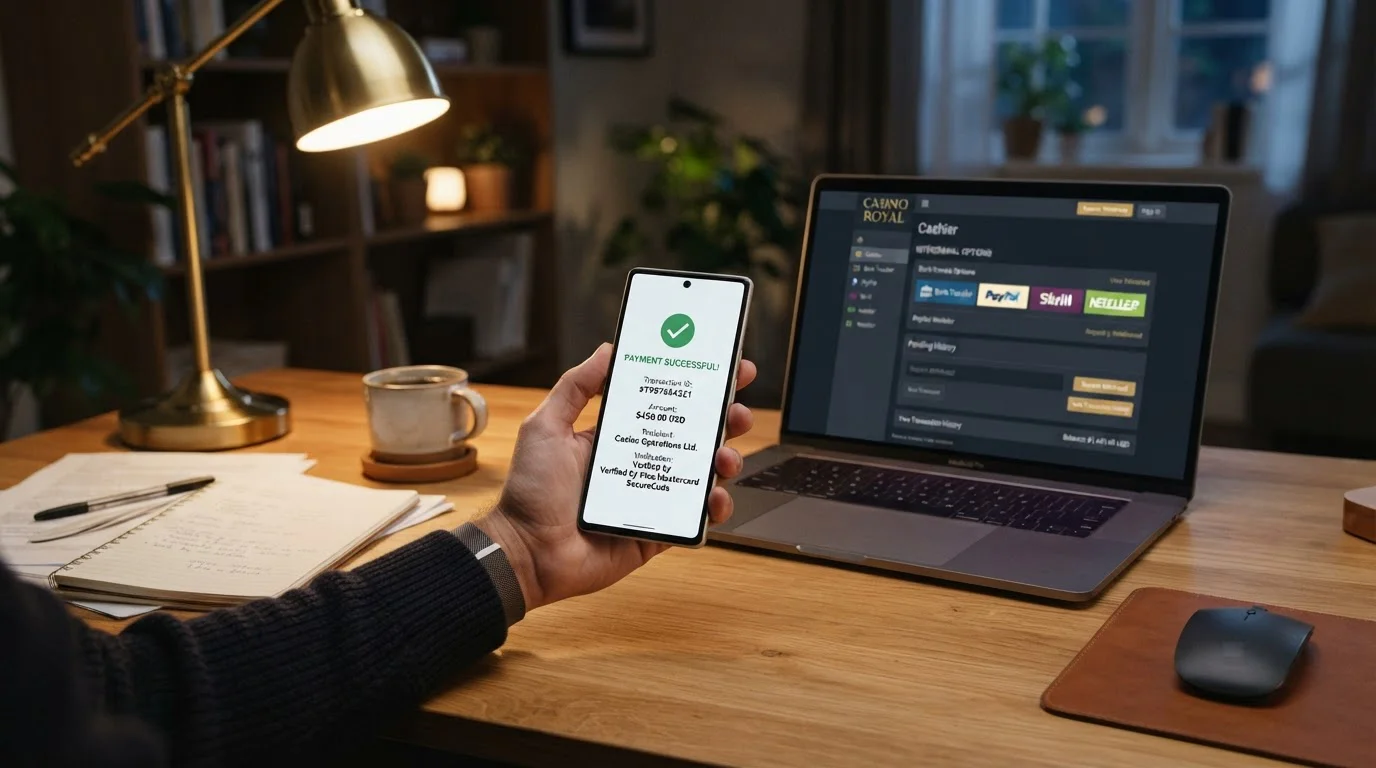
Getting money in. Opening the wallet comes first, and it is the heavier of the two verification jobs. Skrill wants photo ID front and back, a selfie, your source of wealth, your primary intent of use, and an address confirmation — either browser geolocation matched to your registered address or a document no older than 90 days. Clear that and your limits lift automatically.
Funding the wallet is where the first real decision sits. Bank transfer costs nothing and takes one to five business days. Rapid Transfer, the instant bank route via Open Banking, costs 1.00%. Cards cost 1.00% too, with a hard caveat attached: UK-issued credit cards cannot be used for gambling anywhere in the world under Skrill’s own block, and even a non-UK credit card leaves you stuck, because money uploaded by credit card cannot be spent on UK gambling sites at all. PaysafeCard costs 5.00%, which is a lot of money to pay for the privilege of not using a bank. When Skrill asks what the funds are for, answer honestly and answer gambling if that is the plan — purpose of use locks at the moment of deposit, and funds marked non-gambling become excluded funds permanently.
At the cashier itself the sequence is short. Select Skrill, read the minimum shown on the screen, enter an amount, authorise on Skrill’s hosted page, and the money lands in the casino balance immediately. If you have used Skrill 1-Tap at that site before, the redirect disappears: 1-Tap is a subscription you consent to once, with a maximum charge you set at that moment and then promptly forget, and every later deposit processes without leaving the casino. It funds from a Visa or Mastercard or from your wallet balance, and it allows two failed attempts per 24 hours before dropping you back to the standard flow. Cancel it under Settings, then Subscriptions and 1-Tap payments.
Then the casino runs its own check. UK licensees must confirm age, identity and self-exclusion status before you gamble — not necessarily before you deposit, though they are not supposed to leave it until you try to withdraw. Expect to send ID again, and expect a source-of-funds request if the amounts or the pattern of play trip the operator’s anti-money-laundering thresholds. Skrill’s verification buys you nothing here. Two gates, two sets of documents, two institutions with no interest in each other’s conclusions.
Getting money out. Request the withdrawal at the cashier, within whatever limits apply — and both parties impose their own, each adjusted dynamically according to the documentation they hold. The first constraint is the same-method rule: withdrawals return to the deposit method up to the amount deposited. Put £50 in by wallet and the first £50 out goes back to the wallet. Anything above that can take a different route if the operator supports split withdrawals. This is anti-money-laundering practice across the licensed market, driven by the Money Laundering Regulations and the anti-money-laundering licence condition rather than by any rule naming payment methods.
The casino’s approval is the slow leg, and it is the only leg with real variance: around four hours at William Hill, 48 at Betfred, roughly 24 almost everywhere else. Those are compliance queues, not payment rails. Since the Remote Technical Standards were last revised in January 2026, you cannot cancel a withdrawal request once submitted — the cancel button that used to tempt players back into the lobby is gone by regulation.
Once approval clears, the wallet leg is near-instant; Skrill describes incoming merchant payments as instant, and hands-on testing across the comparison sites puts funds in the balance within minutes to an hour. So a site advertising a 24-hour Skrill payout means 24 hours of its own processing, not 24 hours in Skrill’s pipes. The distinction matters because the operator controls the number and Skrill gets the credit or the blame.
Getting it out of the wallet and into something you can spend is the final leg and the one that costs money. To a UK bank account: 1.75%, floor EUR 3.50, landing in under a day or up to five business days. To a Visa or Mastercard that accepts gambling proceeds: 1.99%, floor EUR 0.99, up to three business days. To the Skrill Prepaid Mastercard for cash at an ATM: 1.75%, floor EUR 1.00, instant at the machine. Any leg involving a currency conversion adds 3.99% on top of Skrill’s reference rate.
What is the minimum deposit with Skrill at a UK casino?
£10 at most UKGC-licensed sites. A few (Unibet, Duelz, VoodooDreams) set the floor higher — £20 to £30. The minimum is shown in the cashier before you commit to the deposit. Skrill itself publishes no minimum transaction amount; the floor is the operator’s choice.
How long does a casino withdrawal to Skrill take?
The casino’s approval time plus near-instant receipt in the Skrill wallet once approved. Approval times run from ~4 hours to 48 hours depending on the operator, with 24 hours as the most common claim. Skrill does not control the approval leg — that is the casino running compliance checks. Once approved, the payout lands in your Skrill wallet within minutes to an hour. A “24-hour Skrill payout” means 24 hours end-to-end, not 24 hours inside Skrill’s system.
Can I withdraw to Skrill if I deposited with a debit card?
Not for the amount you deposited with the card. Withdrawals return to the deposit method up to the deposited amount under anti-money-laundering practice across UKGC licensees. If you deposited £50 with a debit card, the first £50 of any withdrawal must go back to that card; only winnings above the deposited amount can go to a different method, and only if the operator supports mixed withdrawals. This is not a Skrill restriction; it is the same rule applied to every payment method under LCCP Licence Condition 12.1.1 (AML compliance).
What Skrill Actually Costs — The Two-Layer Fee Structure
Zero at the casino cashier. Every operator checked charges nothing for a Skrill deposit, and the payout from casino to wallet is also free. The cost appears once money leaves the wallet.
Skrill’s published UK tariff (all fixed amounts stated in EUR even on the UK fees page, which is an editorial detail worth noting):
Deposits into the wallet: bank transfer 0.00%; Rapid Transfer 1.00%; Visa, Mastercard, Maestro, Diners, Discover, JCB 1.00%; PaysafeCash 2.50%; PaysafeCard 5.00%.
Withdrawals out of the wallet: to bank 1.75%, minimum EUR 3.50; to Visa or Mastercard 1.99%, minimum EUR 0.99; SWIFT transfer flat EUR 5.50; to Neteller 3.49%; to crypto 2.00% (but crypto service not offered to UK residents, so this is not a live option).
Send money Skrill-to-Skrill: 2.99%, minimum EUR 0.50, falling to 1.45% at “True Skriller” tier.
Currency conversion: 3.99% on top of the Skrill reference rate on any transaction requiring conversion, applied to Prepaid Mastercard transactions as well.
Dormancy: EUR 5.00 or equivalent deducted monthly after more than 6 months without a login or transaction.
Administration fees: non-compliance EUR 60; chargeback EUR 25; attempted cash upload EUR 10; prohibited transactions EUR 60; wrong-transaction reversal EUR 25.
Skrill’s pages also carry a credit-card caveat: a card issuer may add a “cash advance” fee for gambling deposits, which is outside Skrill’s control and Skrill receives no part of.
Worked example: you deposit £200 from your Skrill balance (so no upload fee), play, win £300, and withdraw to Skrill. The casino-to-wallet leg costs nothing. You then move the £300 to your UK bank account. Skrill charges 1.75% = £5.25, but the floor is EUR 3.50, which at £1.00 = EUR 1.17 (Oct 2026 approximate) is roughly £3.00. The greater of the two applies, so you pay £5.25. If any currency conversion happened (GBP to EUR inside Skrill, or the casino paid in a different currency), add 3.99% on the converted amount. The round-trip wallet cost is £5.25 assuming no FX. That is material against a £25 welcome bonus you forfeited by using Skrill in the first place.
If you leave the money in the wallet and do not log in or transact for six months, Skrill deducts EUR 5.00 monthly from the seventh month onward until the balance is exhausted or you resume activity. The dormancy fee is disclosed in the terms but not highlighted anywhere a casual user would see it before opening the account.

Skrill’s UK credit-card gambling block — under-reported across the comparison sites and directly relevant to “why did my deposit fail”:
Credit cards issued in the United Kingdom cannot be used for gambling transactions anywhere in the world under Skrill’s own restriction. This is Skrill’s rule, not just the UKGC’s rule. The UK sits on a short list (alongside Sweden, Belgium, Australia) where Skrill blocks credit-card-funded gambling outright.
Money deposited into Skrill with a credit card cannot be used on UK or Australian gambling sites even if the card itself is not UK-issued.
Purpose of use is fixed at the moment of deposit. Once funds are in your Skrill balance, their purpose cannot be changed. Funds deposited as non-gambling become excluded funds permanently, and you cannot later redesignate them for gambling. If you told Skrill the deposit was for shopping and then tried to fund a casino, the transaction will be blocked.
Mastercard-funded gambling balances can only be sent to “transfers to selected gambling merchants” from a list Skrill does not publish. A merchant whitelist exists for part of the gambling flow, but its contents are not public, so there is no way to verify whether a specific casino appears on it before attempting the transaction.
Skrill already classifies gambling merchants by merchant category code — the infrastructure to restrict is built, as evidenced by Skrill’s opt-in gambling spending-control block, which declines payments to gambling-merchant MCCs with a 48-hour cool-down on reactivation. The block is at Settings → Verification & features → Spending control, and it stops account-balance payments to gambling sites, Prepaid Mastercard payments at gambling merchants, and Skrill 1-Tap gambling payments. It does not block card deposits made with a gambling purpose of use, does not block payouts from gambling merchants into the wallet, and does not stop pre-existing recurring payments.
The clean takeaway: if your Skrill deposit to a UK casino failed and you funded the wallet with a UK-issued credit card, or you told Skrill the upload was non-gambling, or the casino is not on Skrill’s internal Mastercard-funded-gambling whitelist, the wallet is the thing saying no, not the casino.
Skrill Prepaid Mastercard — a live UK product, not discontinued, but not the same as a Skrill wallet deposit. The card costs EUR 10 to apply, EUR 10 annual fee, 1.75% at ATMs (floor EUR 1.00 from 1 April 2026), 0.50% on money received directly onto the card (floor EUR 1.00), no point-of-sale fees, and the first virtual card is free with EUR 2.50 for additional virtuals. It works at ATMs, online, contactless, and can be added to Apple Pay or Google Pay. No credit check required.
The card arrives at a casino cashier as an ordinary Mastercard payment, not as a Skrill wallet transaction. If the casino excludes Skrill from the welcome bonus, paying with the Prepaid Mastercard does not trigger that exclusion — the casino sees a Mastercard, and Mastercards are almost never excluded. The confusion in searches such as “skrill card casinos” and “casinos that accept skrill debit” stems from conflating the card with the wallet; they are separate rails.
Does Skrill charge a fee for casino deposits?
No. The casino-to-wallet deposit leg and the wallet-to-casino payout leg are both free. Skrill charges nothing for incoming payments from merchants or for sending money to merchants. The fees appear when you move money into the wallet (1.00% for cards or Rapid Transfer, 0.00% for bank transfer) and when you move money out of the wallet to your own bank account or card (1.75% to bank with a EUR 3.50 floor, 1.99% to card with a EUR 0.99 floor). Currency conversion adds 3.99% on any leg requiring it. So the casino cashier is fee-free; the cost is at the wallet’s edges.
What happens to my Skrill account if I stop using it?
After six months without a login or transaction, Skrill deducts EUR 5.00 or equivalent monthly from your balance until the balance is exhausted or you resume activity. This is the dormancy fee, disclosed in the account terms and on the UK fees page. It does not close the account — it drains the balance. To avoid it, log in or transact at least once every six months. A single £1 Skrill-to-Skrill send or a card upload resets the clock.
Skrill at Non-GAMSTOP Sites Breaches Your Own Wallet Contract
Depositing to a non-GAMSTOP casino with Skrill is not illegal for the player, but it is a breach of the player’s own Skrill account agreement, and the wallet holds the money. The structural case no affiliate page makes:
Skrill’s contract forbids it. Clause 11.1 of the Skrill Account Terms of Use prohibits payments for “unlicensed or illegal lotteries or unlicensed or illegal gambling services” — note that unlicensed is a separate, explicit trigger, not merely a synonym for illegal. Clause 11.2 states “it is strictly forbidden to make payments to or to receive payments from persons or entities offering illegal gambling services, including (but not limited to) illegal sports betting, casino games and poker games”, and Skrill “may suspend or terminate your Skrill Account at any time or refuse to execute or reverse a transaction” on belief of such use, directly or indirectly, closing with “it is your responsibility to ensure that you do not use our services for transactions that may be considered illegal.” Clause 11.6 attaches reversal, closure or suspension, a law-enforcement report, damages claims, and an administration fee of EUR 60 per prohibited transaction. Clause 11.7 states “the mere fact that a person or entity accepts payments through us is not an indication of the legality” of what the merchant supplies — which directly refutes the affiliate inference “Skrill processes it, so it must be fine.”
Clause 16.4 permits suspension or termination without notice where the customer breaches the terms or Skrill has reason to believe they are violating any law or regulation. Clause 16.4.4 extends this to a linked Skrill or Neteller account, so the standard workaround “use Neteller instead” shares the same failure domain. Clause 4.4 adds “you may only open a Skrill Account if it is legal to do so in your country of residence… You shall pay us the amount of any losses we incur in connection with your breach.”
The statute. Under sections 33 and 36 of the Gambling Act 2005, a Curaçao- or Anjouan-licensed site knowingly serving GB customers is providing unlicensed gambling facilities in Great Britain — a criminal offence by the operator (section 33, up to 51 weeks’ imprisonment and/or a level 5 fine). Section 36(3), as substituted by the Gambling (Licensing and Advertising) Act 2014 (in force 1 November 2014), bites where equipment is in Great Britain or where “no such equipment is situated in Great Britain but the facilities are used there.” Section 36(3A) specifies the provider commits the section 33 offence “only if the person knows or should know” the facilities “are being used, or are likely to be used, in Great Britain.”
Criminal liability sits on the operator. There is no mirror offence for the individual player. The player’s exposure is contractual (their own Skrill terms, breached at clause 11.1) and practical (no recourse if things go wrong) — not criminal. But the contractual exposure means Skrill can reverse the payment, close the account, withhold the balance pending KYC review, charge EUR 60 per prohibited transaction, and extend the action to any linked Neteller account.
The Ombudsman asymmetry — an original angle. The Financial Ombudsman Service does not cover casinos, because gambling is not an FCA-regulated activity. But the Ombudsman does cover Skrill, as an FCA-authorised e-money institution. So the only functioning ombudsman route in the arrangement is pointed at the player’s own wallet provider, never at the party that took the bet. Three published final decisions from the last eighteen months illustrate what that means in practice:
DRN-6040852 (22 December 2025): Mr C opened a Skrill account in March 2024 “so that he could use online betting sites without having to use his main bank account.” He received £407.92, £370.00 and £4,000.00 from two betting merchants, shown on statement as “Gaming Payment Transaction.” Skrill audited, rejected his evidence, closed the account with immediate effect and withheld the £4,457.67 balance less a “Repair Fee” of £52.19. The Ombudsman found Skrill entitled to review and to close, but ordered the balance released with 8% interest from 8 August 2024, the fee refunded and £350 for distress. Skrill did not accept the investigator’s recommendation and did not respond to the provisional decision — the money moved only after roughly 17 months of escalation.
DRN-5640109 (23 September 2025): Ms B’s account closed 26 September 2024 after KYC documents “didn’t meet its security and verification criteria.” Balance withheld. Complaint not upheld — “I won’t be directing Skrill to release the money held in the account.” The Ombudsman received Skrill’s evidence in confidence, so the customer was never told what was wrong with her documents.
DRN-4954474 (2 September 2024): Mr S, online-gaming-related income, account closed August 2023, just over $2,500 USD retained. Not upheld.
The pattern: freezes and balance retentions are real and routine, and resolve against the customer about as often as for them. In all three the trigger was KYC and source of funds, not a finding that the merchant was unlicensed — no published Ombudsman decision was found in which Skrill explicitly cited an unlicensed gambling merchant as the closure reason. That specific enforcement path is unverified as to frequency, but the contractual right to use it sits in the terms at clause 11.1 and 11.2.
Recourse. With a UKGC licensee a UK player has mandatory alternative dispute resolution (the operator must appoint an approved ADR provider), IBAS binding decisions up to £10,000 for the 1,292 operators in its directory, eCOGRA for sites that engaged it, LCCP Licence Condition 4.2.1 customer-funds-protection disclosure (three tiers: not protected / medium / high, with biannual re-warning from 31 October 2025 for operators rated “not protected”), and segregation under LCCP 4.1.1. With an offshore site: none of the above. GAMSTOP participation has been mandatory for UKGC remote licensees since 31 March 2020 (SR Code 3.5.5), and offshore sites never query the database.
Enforcement. The UKGC reported 397,527 URLs to search engines in 2025-26 with 266,667 removed (roughly 67%), 741 cease-and-desist notices, 1,068 sites referred for delisting, and 1,134 sites disrupted. In 2024-25, 264 unlicensed sites were stopped from operating in GB, a 46% traffic drop was observed at the largest illegal domains after 2023 geo-blocking, and UK online channelisation reached around 97.6%. Andrew Rhodes, Chief Executive: “Many of the sites we deal with are determined, persistent and adaptable.” A new power — court-ordered suspension orders compelling ISPs to block domains and IPs, via the Criminal Justice Bill, extraterritorial in scope — is pending commencement. £26m of Exchequer funding over three years (£5m in 2026/27, then £10m twice) backs the illegal markets unit, detection technology that follows domain migration, and litigation. Payment disruption is already in the Commission’s toolkit.
Does Skrill work there in practice? Every source asserting it does is an affiliate page earning commission on signups. The most explicit names 15 Curaçao brands and claims accounts were funded by Skrill at each, while conceding its figures are “realistic estimates rather than verified current data.” Independent verification largely failed: comparison sites return 403, cashier pages are client-rendered and expose no methods, and Paysafe publishes no gambling-merchant licensing policy. What is solid: Paysafe markets iGaming services across “90+ regulated global jurisdictions”, and the named examples are regulated markets. Several affiliate-listed brands (MyStake, Freshbet, Goldenbet, Rolletto) sit under the same Santeda International / Curaçao umbrella, so “15 independent options” overstates diversity. Even affiliates concede Skrill is excluded from welcome bonuses at several and that crypto is faster. Both directions remain unproven: “Skrill was withdrawn” is unproven, and so is “Skrill is reliable here.”
Verdict. Where it currently works, it works because an offshore acquiring arrangement has not yet been switched off, not because Skrill sanctions it. The wallet’s contract forbids unlicensed gambling, the player’s only ombudsman route is against the wallet not the casino, and account freezes over gambling transactions are documented and routine. Using Skrill at a non-GAMSTOP site is not a crime for the player, but it is a breach of their own agreement with the party holding their money.

Can I use Skrill at casinos not on GAMSTOP?
Skrill’s account terms forbid payments to entities offering unlicensed or illegal gambling services (clause 11.1 and 11.2), with account closure, transaction reversal and a EUR 60 fee per prohibited transaction as the stated consequences (clause 11.6). Under sections 33 and 36 of the Gambling Act 2005, a Curaçao-licensed site knowingly serving GB customers is providing unlicensed gambling facilities in Great Britain. Criminal liability sits on the operator, not the player — there is no offence for the individual. But the player’s exposure is contractual: they are breaching their own Skrill agreement, and Skrill holds the money. Three Financial Ombudsman decisions from 2024-2025 show account freezes and balance retentions over gambling transactions are real, and two of the three were decided against the customer. Where Skrill works at offshore sites today, it works because an acquiring arrangement has not been shut off, not because Skrill sanctions it. The only ombudsman route you have is against the wallet, never against the casino.
Skrill’s UK Regulatory Position and Player Protection
Skrill Limited — FCA firm reference 900001, company number 04260907, registered at 1st Floor, 2 Gresham Street, London EC2V 7AD, authorised under the Electronic Money Regulations. Paysafe Financial Services Limited — FRN 900015, company number 4478861, same address. Paysafe Payment Solutions Limited — Irish company 626665, 15 George’s Quay, Dublin 2, regulated by the Central Bank of Ireland, registration C184986, trading as Skrill, Rapid Transfer and Skrill Money Transfer. Group parent Paysafe Limited, Victoria Place, 31 Victoria Street, Hamilton, Bermuda.
UK customers currently contract with PPSL (the Irish entity) under terms valid from 5 March 2026, governed by Irish law and Central Bank of Ireland supervision. A parallel future-dated terms set (valid from 1 February 2027) names PFSL (FCA e-money register 900015, London). The site footer reads “Paysafe Payment Solutions Limited, trading as Skrill, Rapid Transfer and Skrill Money Transfer is regulated by the Central Bank of Ireland”; the copyright line reads “© 2026 Skrill Limited.” The transition is in progress but the scope of UK-account migration is not stated in any customer-facing notice. Treat it as published regulatory positioning rather than a completed move, and if asked which entity you contract with, the answer as of October 2026 is PPSL Ireland under the live terms, with PFSL London named in future-dated terms from February 2027.
APP fraud reimbursement. UK customers have reimbursement rights from 7 October 2024: maximum £85,000, £100 excess (waived for vulnerable customers), claims within 13 months, Faster Payments and CHAPS UK-to-UK transactions only, escalation to the Financial Ombudsman Service. Source: Skrill help centre question 214 and clause 6.7.4 of the PFSL terms. This is a UK regulatory protection applying to UK-authorised payment service providers, which supports the read that a UK FCA-authorised entity is in the customer chain even where the primary contract names the Irish entity.
Credit card ban. Came into force 14 April 2020 under LCCP Licence Condition 6.1.2. Exact wording: “Licensees must not accept payment for gambling by credit card. This includes payments to the licensee made by credit card through a money service business.” The ban explicitly extends to e-wallets. The UKGC’s August 2019 consultation stated “unless this current lack of transparency is addressed, a prohibition… could be easily circumvented by making a credit card deposit into an e-wallet instead of a direct payment to the gambling operator”, and the consultation specifically named Skrill and Neteller as e-wallet providers making up part of the 11% of deposits via e-wallets in the pre-ban market. Skrill’s own UK credit-card gambling block (covered in the fees section above) implements this on the wallet side.
Customer funds protection. Three levels under LCCP Licence Condition 4.2.1: not protected (any money in the account is part of the operator’s assets if it goes insolvent, and the player would likely lose it); medium protection (arrangements such as insurance, but repayment not guaranteed); high protection (funds in a formal trust account legally separate from the operator, with independent trustee or auditor oversight — the best chance of recovery). Operators must state the level, obtain written acknowledgement before the customer gambles, and from 31 October 2025 operators rated “not protected” must remind customers every six months with acknowledgment required before further gambling. Money staked or deposited with a gambling operator is not protected by the UKGC or government — no compensation scheme exists.
Verification before play. All online gambling businesses must verify age, identity and self-exclusion status before a customer gambles or places a bet, under LCCP Licence Condition 17.1.1 and related SR codes. The 72-hour window operators previously had to verify age has been removed. Verification is not necessarily required before deposit, but operators should not delay it until withdrawal. As covered in the deposit mechanics section, the casino and the wallet each run their own check, and passing one does not satisfy the other.

Do I need to verify my identity twice when using Skrill at a casino?
Yes. Skrill runs KYC (photo ID, selfie, source of wealth, address verification), and passing it unlocks your Skrill deposit and withdrawal limits. The casino runs a separate, independent check for age, identity and self-exclusion under UKGC rules, and passing Skrill’s verification does not satisfy the casino’s requirement. You will be asked for ID again, and possibly for source-of-funds documentation if your deposit amount or play pattern triggers the operator’s AML procedures. Two gates, two checks, and neither exempts you from the other.
Games You Can Play with a Skrill Balance
The wallet funds everything a UKGC-licensed casino offers — online slots, live dealer tables, roulette, blackjack, baccarat, poker, bingo. Skrill deposits and casino play are entirely separate things: the wallet is a payment rail, not a game provider, so the game library is the operator’s, not Skrill’s. The confusion in searches such as “skrill slots”, “what is skrill slots” and “is skrill slots legit” stems from a false premise that “Skrill Slots” is a product or a casino brand. It is not. Skrill makes no games.
Where the wallet intersects game rules is the stake cap. From 9 April 2025 players aged 25 and above face a £5 maximum stake per spin on online slots (SI 2025/215), and from 21 May 2025 players aged 18–24 face a £2 maximum. The cap applies to the game, not the payment method, so funding with Skrill does not exempt you. Game design rules under the Remote Technical Standards reinforce the cap: RTS 8A bans autoplay (each game cycle requires individual customer commitment), RTS 14D sets a minimum 2.5 seconds between slot spins, RTS 14E bans turbo and slam-stop features, RTS 14F requires systems not to celebrate returns less than or equal to stake, and RTS 14C bans simultaneous play across multiple games. Published 2 February 2021, RTS 14 last updated 12 January 2026.
Live dealer tables, roulette, blackjack and poker sit outside the online-slot stake cap. The wallet funds them the same way it funds slots — instant deposit from account balance or 1-Tap, payout back to the wallet once the casino approves the withdrawal. The same minimum deposits apply (£10 to £30 depending on operator) and the same bonus-exclusion issue applies if the offer you are chasing bars Skrill deposits.
Skrill Alternatives for UK Casino Deposits
If the bonus is worth more than speed, or Skrill’s fees or credit-card block rule it out, here are the alternatives on the axes that matter.
| Method | Instant Deposit | Withdrawal Support | Typical Minimum | Bonus Eligibility | Fees |
|---|---|---|---|---|---|
| Neteller | Yes | Yes | £10 | Excluded as often as Skrill | Similar to Skrill (1.9% withdraw to card, 1.75% to bank) |
| PayPal | Yes | Yes | £10 | Rarely excluded | Free at casino; PayPal’s own fees apply wallet-to-bank |
| Apple Pay | Yes | Rare | £10 | Rarely excluded | None at casino; card issuer may charge |
| Google Pay | Yes | Rare | £10 | Rarely excluded | None at casino; card issuer may charge |
| Bank Transfer | No (1-5 days) | Yes | £10-£20 | Rarely excluded | Free |
| Debit Card | Yes | Yes | £10 | Rarely excluded | None |
Neteller is Skrill’s sibling (both Paysafe-owned) and carries the same bonus-exclusion problem, the same fee structure, and the same clause 16.4.4 extension in Skrill’s terms meaning a Skrill account closure for prohibited gambling can reach your linked Neteller account. If you are switching to dodge a Skrill exclusion, Neteller is not the answer — operators that exclude one usually exclude both.
PayPal is rarely excluded from welcome bonuses at UK casinos, supports instant deposits and withdrawals, and UK players trust it. Minimum deposits are typically £10. PayPal charges no fee for incoming merchant payments (so casino-to-PayPal is free), and outbound fees depend on whether you are moving money to your bank, your card, or another PayPal user. The brand recognition and lighter bonus-exclusion footprint make it the closest functional replacement for Skrill if the exclusion is the dealbreaker.
Apple Pay and Google Pay are card-tokenisation layers — they pass a virtual card number to the casino, and the casino sees it as a card payment, so card-based welcome offers accept them. Instant deposit, but withdrawal support is rare (most operators can pay out to a card but mobile-wallet-specific payout is uncommon). No fee at the casino cashier; the card issuer may add charges.
Bank Transfer is free and rarely excluded from bonuses, but it is slow (1–5 business days to deposit, similar on withdrawal). Minimum deposits are typically £10–£20. If speed does not matter and you want the bonus, bank transfer is the safest method — universally accepted, no exclusions, no fees, but patience required.
Debit Card (Visa or Mastercard) is the baseline: instant deposit, widely supported for withdrawals, almost never excluded from bonuses, no fees at the casino. UK-issued debit cards work everywhere a UK-licensed casino operates. If you are taking a welcome offer, fund with a debit card unless the terms explicitly state otherwise. The trade-off against Skrill: the card payout leg can be slower (up to 3 business days per Skrill’s own help centre for card withdrawals out of a Skrill wallet, and similar from a casino to a card), whereas Skrill-to-wallet is near-instant once approved. But the bonus eligibility tips the scales.
The decision rule: if the welcome offer is worth more than one or two days of payout speed, use a debit card or PayPal. If you are redepositing winnings already sitting in your Skrill wallet and the instant round-trip matters more than a bonus you will not roll over, use Skrill. If you are credit-card-funding the wallet or you are outside GAMSTOP and Skrill’s own terms become the exposure, Skrill is the wrong choice.
Mobile and App Play with Skrill
Most Skrill casino deposits happen on a phone, and the wallet is built for it. Skrill 1-Tap in particular is mobile-first: the first transaction establishes the subscription with a maximum charge amount set, and later payments process without leaving the casino app or mobile site — no redirect, no re-authentication, the charge goes through in the background. Funding for 1-Tap is restricted to Visa or Mastercard (debit or credit, though UK credit cards are blocked for gambling under Skrill’s own rule) or Skrill account balance. Security throttle: two failed attempts per 24 hours, then you are back to the redirect flow. Manage or cancel 1-Tap subscriptions under Settings → Subscriptions and 1-Tap payments in the Skrill app or web account.

Rapid Transfer (instant bank transfer via Open Banking) works on mobile: you select it at the casino cashier, authenticate via your banking app, and the transfer completes without leaving the session. Skrill Limited appears in the Open Banking regulated-provider directory in connection with Rapid Transfer. Cost: 1.00% to upload into the Skrill wallet.
The Skrill Prepaid Mastercard (live UK product, covered in the fees section) can be added to Apple Pay or Google Pay and used for contactless mobile payments and in-app purchases. It arrives at a casino as a Mastercard, not as a Skrill wallet transaction, so it sidesteps the Skrill bonus exclusion if the casino accepts Mastercards for the offer.
Skrill’s mobile app (iOS and Android) handles account balance, transaction history, KYC document uploads, deposit-limit tracking, and the gambling spending-control block toggle. Verification happens in-app: photo ID, selfie, proof of address. The app also hosts the Skrill Knect loyalty programme — 10,000 Knect points convert to EUR 10 cash, earned by transacting with Skrill at merchants. VIP tiers (Silver at EUR 15,000 quarterly volume, Gold at EUR 45,000, Diamond at EUR 90,000) drop the crypto spread and the send fee, though per-tier benefits beyond that are not detailed on Skrill’s current pages.
UK-licensed casino sites are required to be mobile-responsive or to ship native apps under ordinary web-accessibility expectations, so the combination of a mobile-optimised Skrill flow and a mobile-optimised casino means the deposit-to-play sequence works end-to-end on a phone without friction. The bonus-exclusion and fee-structure issues are identical on mobile and desktop — the device does not change the economics.
Casino Deposit Methods UK 2026 — Compare Payment Options
Content created by the «casinopayexp» team